
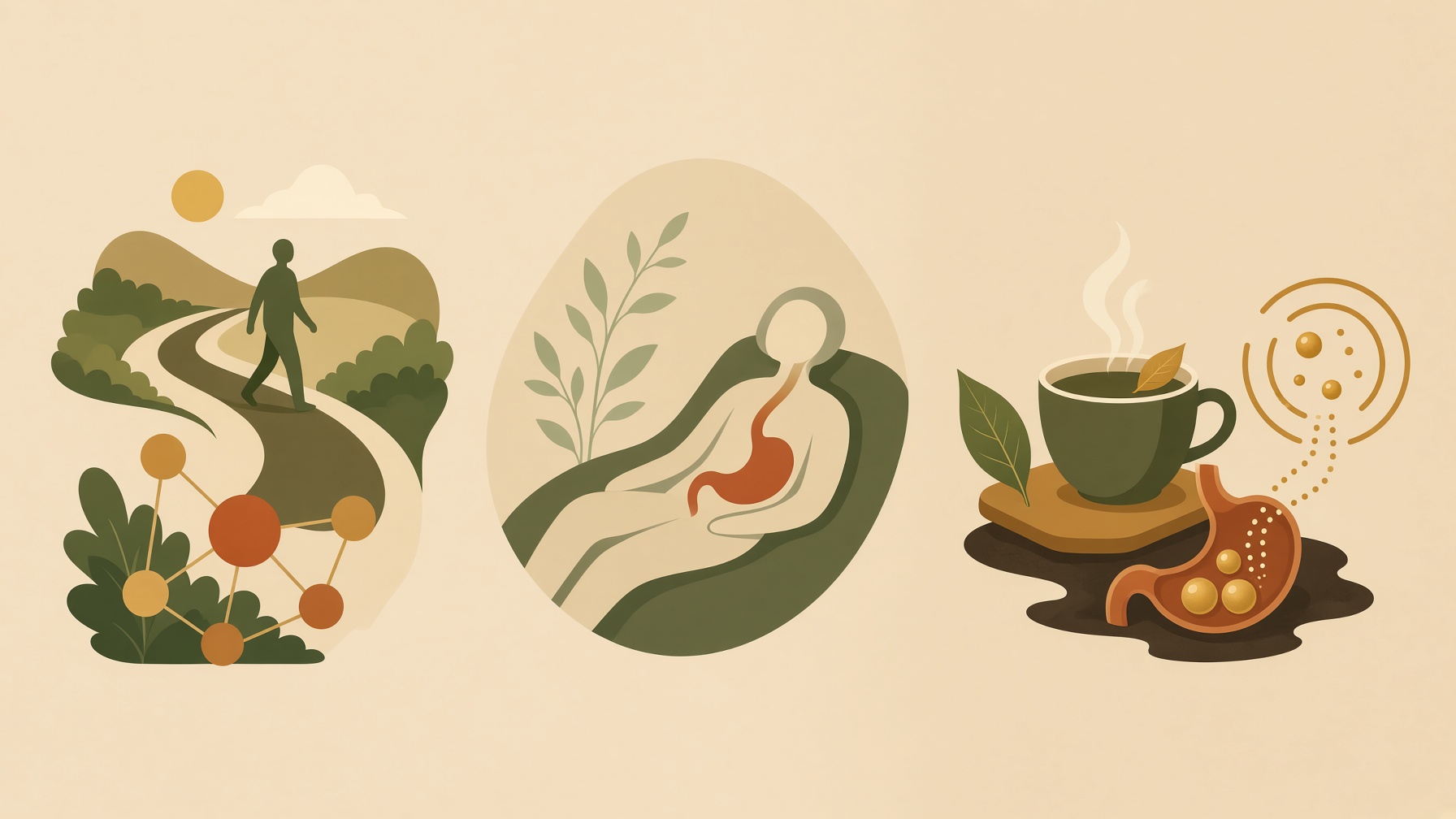
You finish lunch, reach for a cup of tea, and remember a rule about waiting. Another rule warns against lying down; someone else insists that walking is a mistake. It can be hard to tell which of these familiar instructions answers a real question and which has simply become part of the conversation around food.
The difficulty is that these rules are not really competing answers to one question about “digestion.” Lying down is usually discussed in relation to reflux, walking in relation to the post-meal glucose response, and tea in relation to absorption of non-heme iron. Once the outcome changes, the meaning of the rule changes with it.1,2,3
The advice about lying down concerns reflux, when stomach contents move back toward the esophagus. An evidence-based consensus for people with reflux-like symptoms supports avoiding lying down after meals, particularly when symptoms follow eating or occur at night. Its purpose is symptom management in that context. It does not establish that everyone needs a timed period of standing after every meal, or that sitting down prevents normal digestion.1
Walking addresses a different outcome. A review of eight small crossover trials found that activity after eating reduced the immediate rise in blood glucose compared with inactivity or activity before the meal. The trials involved 116 participants and had a high overall risk of bias. This finding challenges a blanket ban on post-meal walking, but it is not a verdict on every aspect of digestion or a universal timetable for exercise.2
Tea raises a more specific question about absorption. Its polyphenols can reduce absorption of non-heme iron, a form found in plant foods and mixed diets. The effect depends on the drink and the meal, among other factors. In a controlled study of women with adequate iron stores, tea taken one hour after an iron-containing meal inhibited iron absorption less than tea taken with the meal. That was a measurement of absorption under controlled conditions, not proof that an after-lunch cup causes iron deficiency or that an exact one-hour interval is necessary for everyone.3,4
Longer-term iron status depends on more than one meal. A review of tea consumption found no basis for restricting tea among healthy people without elevated iron-deficiency risk, while identifying greater reason for attention when that risk was present. The useful distinction is between a measurable effect on one nutrient and a broad claim that tea is “bad after food.”5
Seen together, the three habits do not produce one universal post-meal rule. The relevant question is what outcome is actually being discussed: reflux symptoms, the short-term glucose response, or iron absorption. Treating those as the same problem is what makes everyday advice sound more contradictory than the evidence itself.1,2,3,4,5
An ordinary lunch need not end with a checklist of prohibitions. When a familiar rule comes up, it is reasonable to ask what problem it was meant to address. That makes for a more useful conversation than adding another “never” to the table.

Join the discussion
No account or email is required. Your display name and comment will be public.