
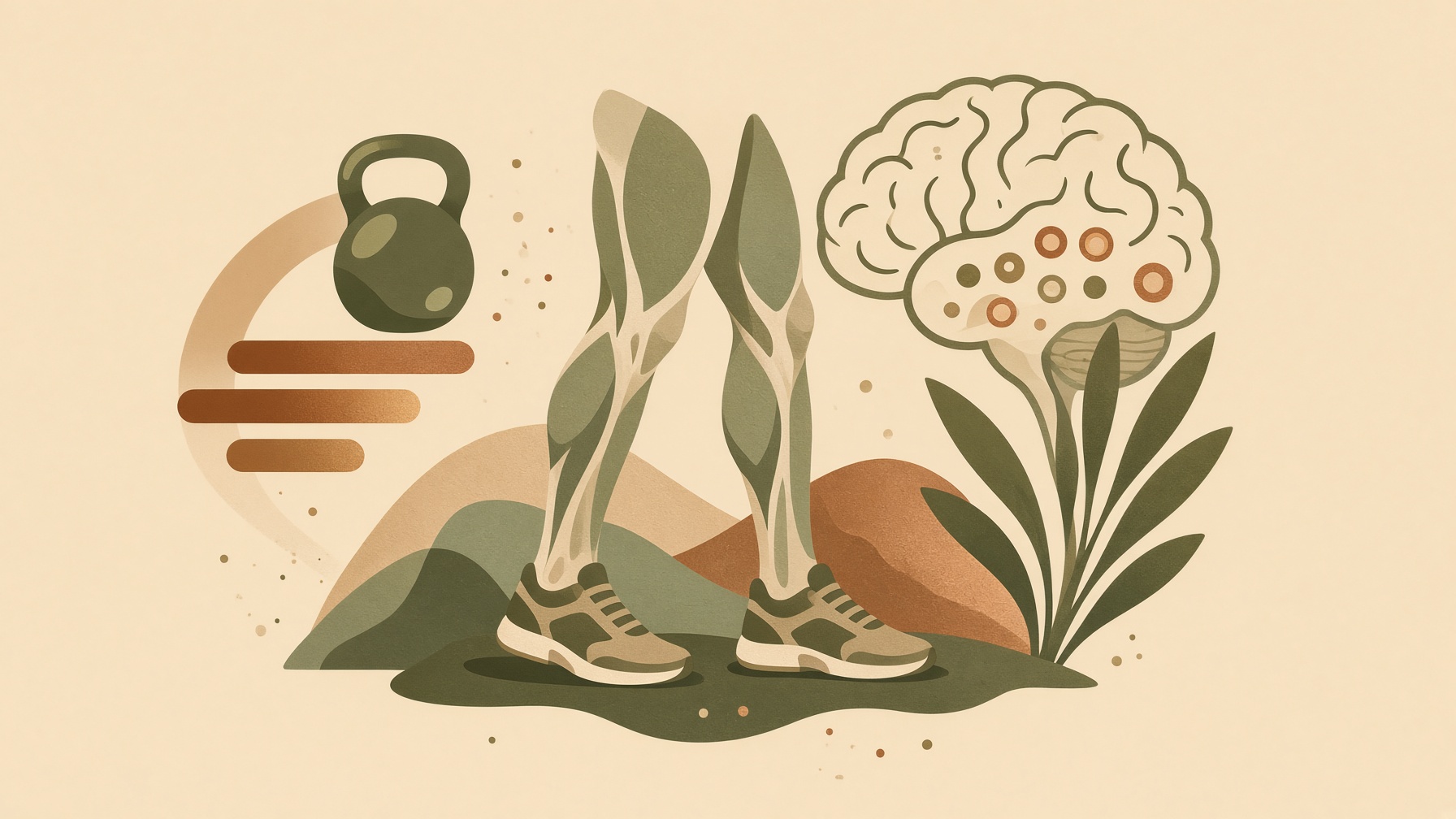
Stronger legs fit naturally into our ideas about staying physically capable. Staying mentally sharp as we grow older can feel like a separate concern. If the two are connected, are stronger legs a sign of how the brain is aging, or a way to influence it?
Among middle-aged and older female twins, higher leg power at the start of a study predicted more favorable cognitive change over ten years. The women performed a leg-extension power test using their dominant leg. This measured a feature of physical performance, rather than maximal strength or muscle size. Visual memory and processing speed were combined into a cognitive score, allowing changes in those abilities to be followed across the decade. The women were observed rather than assigned exercise, so the association leaves open whether training to increase leg power would produce the same outcome.1
A trial randomly assigned independently living women aged 65–75 without neurodegenerative disease to different exercise programs. The resistance programs were progressive, with demands increasing as training went on. After a year, whole-body resistance training improved performance on a Stroop task compared with balance and toning exercises. Both conditions involved exercise; the comparison was between different kinds of program. The timed Stroop task tested selective attention and conflict resolution: giving the required response despite competing information.2
The comparison tests what a program changes, rather than what a leg measurement predicts. Pinning the improvement on stronger legs would require showing that increased leg strength accounted for that cognitive change. This trial did not establish that link. The twins' leg-power result and the training result can therefore inform the same question without supplying the missing causal step between them.1,2
The two studies also followed different aspects of thinking over different periods. A decade of change across memory and processing-speed tests is not the same outcome as a one-year change in a specific attention task. The findings support leg power as a marker in one group of women and a benefit of a training program for one cognitive outcome in another. They do not establish that increasing leg power itself prevents cognitive decline, and neither study tested Alzheimer's prevention.1,2
It makes sense to be interested in a connection between stronger legs and clearer thinking. You may want to know what a leg measurement tells you, or what exercise might change. Those are different questions, even when they come from the same everyday goal: staying able to do the things you enjoy as you get older.


Join the discussion
No account or email is required. Your display name and comment will be public.