
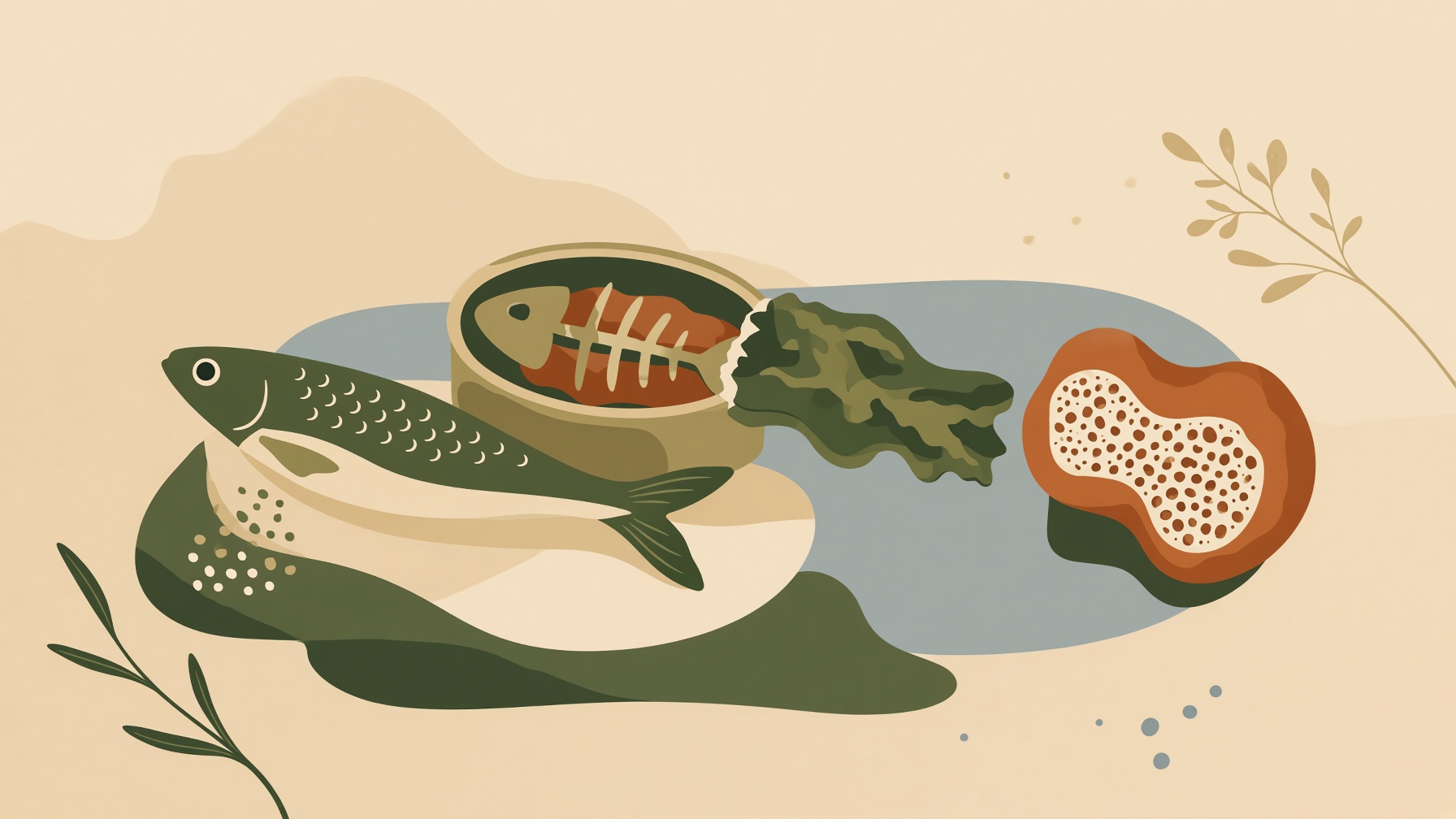
A calcium value for sardines looks straightforward until you compare its food description with the portion on your plate. If you leave the bones behind, does the same number still apply?
One USDA entry is quite specific: Atlantic sardines canned in oil, drained solids with bone. In the 2015 Standard Reference release, record NDB 15088 gives a calcium mean of 382 milligrams per 100 grams of edible portion. That is a historical reference value for the described food, not an exact assay of every brand of canned sardines. “With bone” belongs to the identity of the material represented by the number.1
The database’s reporting basis is 100 grams of edible portion. Its documentation supplies food descriptions and refuse fields to help identify the material to which nutrient values apply. Here, the description explicitly includes bone in the drained solids. “Edible portion” therefore cannot simply be read as whatever a particular eater happens to leave after removing parts.1,2
Discarding tissue included in that preparation breaks the precise match between the record and the remaining food. The original calcium value can remain correct for its described material while no longer precisely describing what is on the plate. Knowing the mass of the remaining portion does not resolve that difference in food identity. A serving calculation cannot substitute for matching the preparation first.1,2
That mismatch does not reveal how much calcium remains. The entry is not a matched experiment comparing sardines before and after bone removal, so it cannot supply an isolated calcium contribution from bones or a known amount to subtract. Checking the full record description is the supported practical step. The number describes calcium present in the specified food; it does not measure calcium absorbed by the body or provide a recommendation about eating bones.1,2
Before reaching for a calculator, return to the description beside that calcium number. Does it describe the sardines you are actually eating? That is the question to settle before turning a database entry into an answer about your plate.
Join the discussion
No account or email is required. Your display name and comment will be public.