
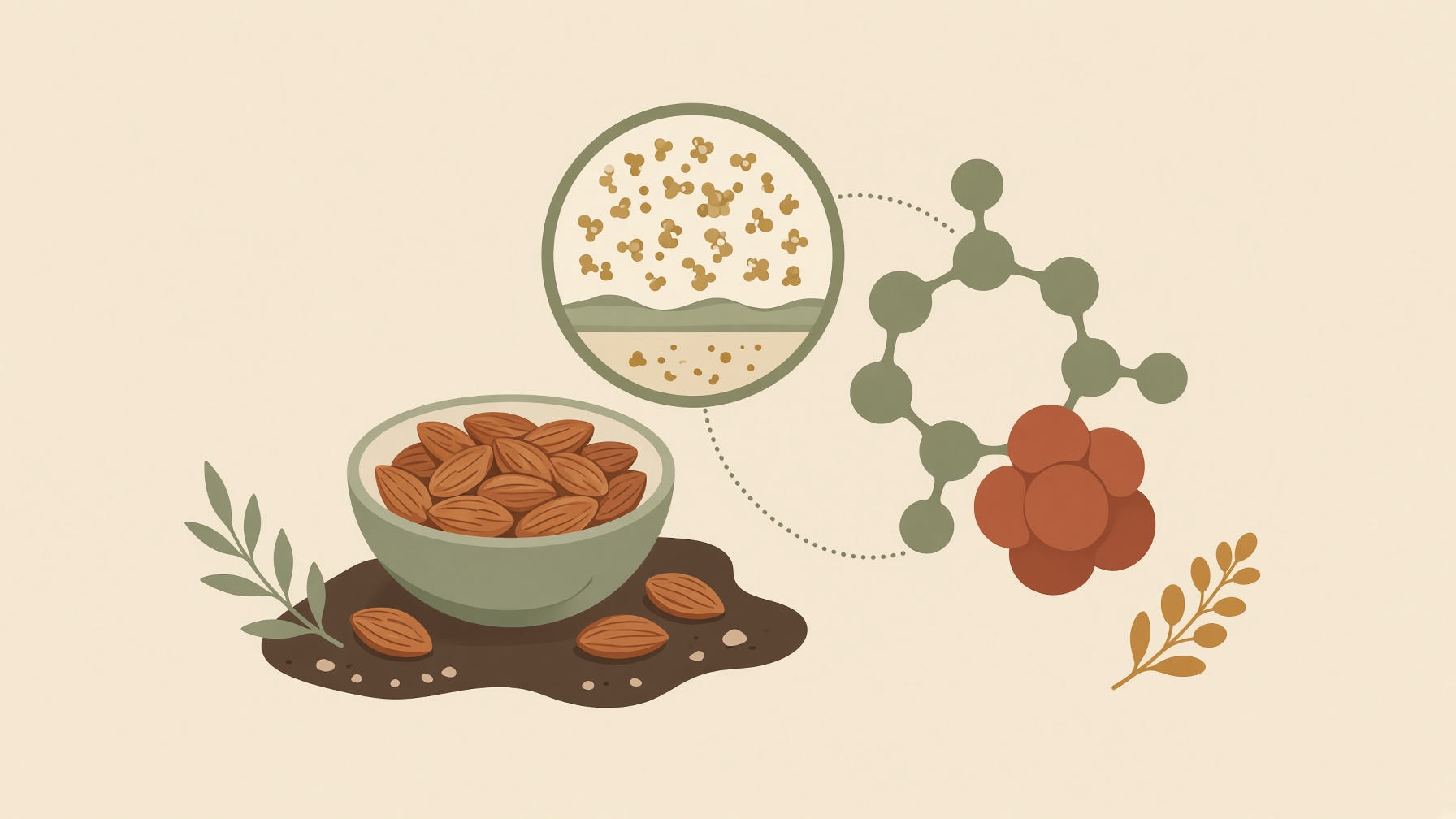
You come across a tip to soak almonds overnight before eating them. The explanation points to phytate and iron, and you want to see the comparison for yourself. What exactly was done to the almonds, and what do the numbers mean? Those are the questions to bring to this particular preparation.
Phytate is a naturally occurring plant compound that can bind minerals. The relevant comparison placed whole, raw, undried almonds alongside almonds that had been chopped, soaked for 12 hours with salt and then dried. Five purchased brands served as replicates in a preliminary laboratory experiment reported in an open master’s thesis from the University of Otago, dated 2017 and published in its repository in 2018. This was a comparison of complete preparations, so any difference could not be assigned to soaking alone.1
Phytate’s numerical estimate was lower after the combined preparation: 508 rather than 531 milligrams per 100 grams. Yet that pairwise difference was not statistically significant. The reported 95% confidence intervals were 483–533 for the prepared almonds and 506–556 for the raw almonds. Iron concentration also fell, from 3.5 to 3.0 milligrams per 100 grams, and that pairwise difference was statistically significant. Its corresponding intervals were 3.2–3.8 for raw almonds and 2.7–3.3 for prepared almonds.1
The phytate-to-iron balance moved upward. The reported molar ratio rose significantly in the pairwise comparison, from 12.9 to 14.4. A molar ratio compares amounts in moles rather than milligrams; it is not obtained by simply dividing the two milligram figures. Its direction illustrates a familiar feature of ratios: the numerator can fall while the ratio rises if the denominator falls by a greater proportion. The lower phytate estimate did not translate into a lower phytate-to-iron ratio because iron also changed.1
Those concentrations referred back to the purchased material. They had been corrected for mass lost during drying, rather than left on an uncorrected dried-weight basis. That reporting choice does not provide a complete account of where the minerals went. Neither the soaking water nor complete mineral recovery was assayed, so the figures cannot establish an exact amount of iron lost into the water.1
The chemical comparison did not measure absorption into the body: there was no human feeding or tracer test. It establishes neither an absorption benefit nor that improvement is impossible, and it does not settle the result for other nuts or home recipes.1
When assessing a claim about preparing almonds, ask for the proposed benefit to be defined. Is the question about a chemical change, the amount of a nutrient, or a benefit from eating the food? Then ask what comparison would address that question. Keep any conclusion limited to the preparation and outcome that were actually assessed.
Join the discussion
No account or email is required. Your display name and comment will be public.