
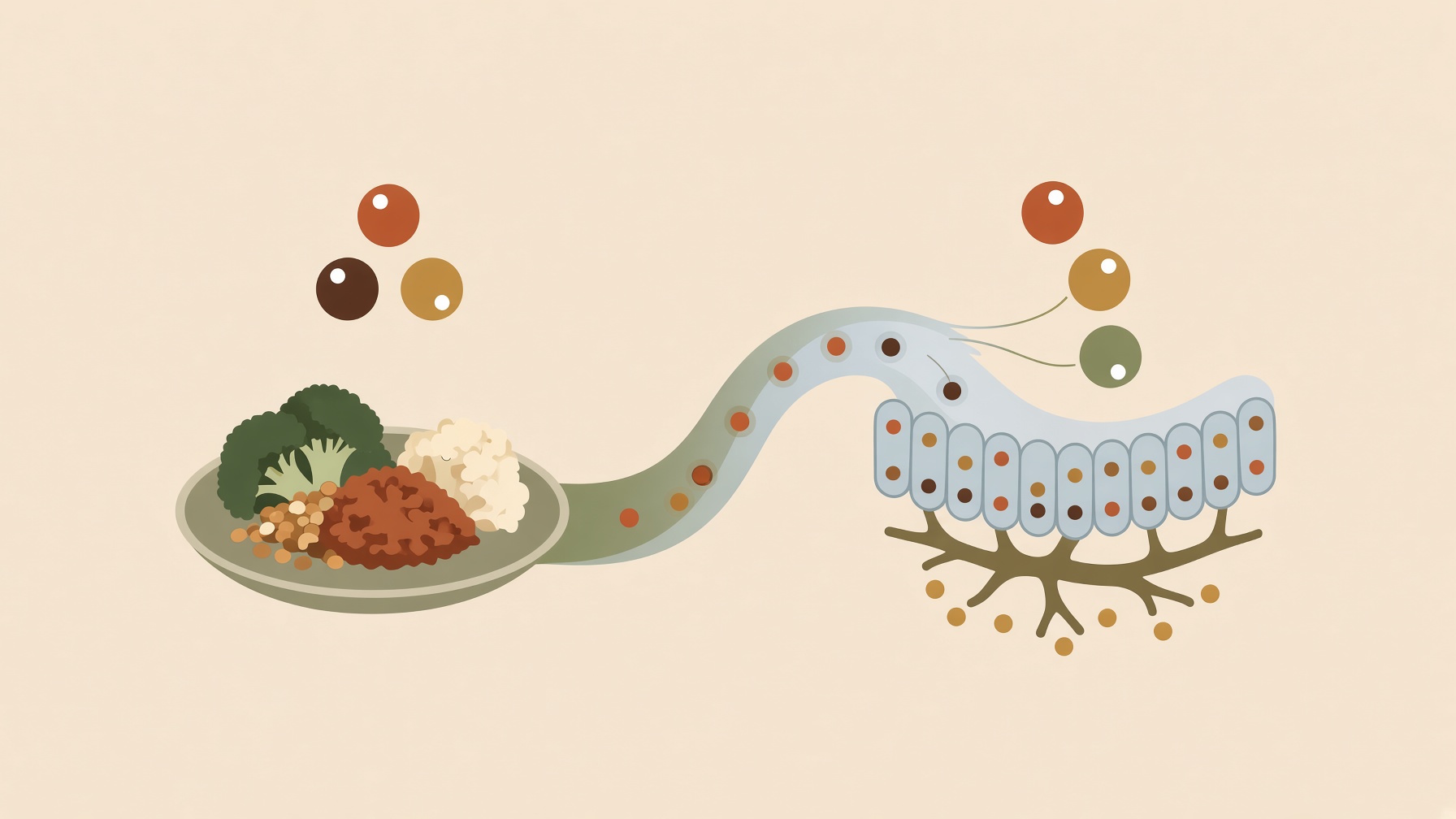
Two meals can contain the same number of milligrams of iron and still provide different amounts of absorbable iron. That is because the number on a food label or nutrient database describes how much iron is present, not how much the body will necessarily absorb. Iron's chemical form, the rest of the meal, and the person's iron status all influence bioavailability.
The first distinction is between heme and nonheme iron. Heme iron is generally more bioavailable than nonheme iron. Meat, poultry, and seafood contain both heme and nonheme iron. Iron in plant foods and iron-fortified plant foods is nonheme iron. This difference in chemical form helps explain why equal amounts of dietary iron are not automatically equivalent in terms of absorption. Even so, food source and iron form are not the whole story. A person's existing iron status also strongly influences absorption, because the body adjusts iron uptake according to its needs and stores .1,3
Meal composition matters especially for nonheme iron. Phytate can reduce its absorption, and some dietary polyphenols can do the same. The effect of polyphenols is not uniform: it depends on factors such as the type and amount consumed, their timing, and the composition of the meal. Vitamin C has the opposite effect. When consumed with a meal, it can enhance nonheme iron absorption. These interactions show why iron bioavailability is better understood at the level of the whole meal rather than as a fixed property of one iron-containing food. What accompanies that food can change how much nonheme iron becomes available for absorption .1,2,3
Broad estimates of iron bioavailability can still be useful, but they require context. Under commonly used reference assumptions, average bioavailability is often estimated at about 14 to 18 percent for mixed diets and about 5 to 12 percent for vegetarian diets. These values are population- and diet-level modeling estimates, not guaranteed absorption rates for a specific person or meal. The bioavailability of vegetarian diets can vary depending on iron status, food selection, preparation methods, and meal composition. The same principle of individual variation applies more broadly across dietary patterns .1,3
The amount of iron listed in a food is therefore only the starting point for understanding iron nutrition. Heme and nonheme iron differ in bioavailability, other foods in the meal can either inhibit or enhance nonheme iron absorption, and the body's iron status influences how much iron is taken up. As a result, two diets with similar iron content can provide different amounts of absorbable iron, and broad bioavailability estimates should be viewed as reference assumptions rather than precise predictions for an individual.
Join the discussion
No account or email is required. Your display name and comment will be public.