
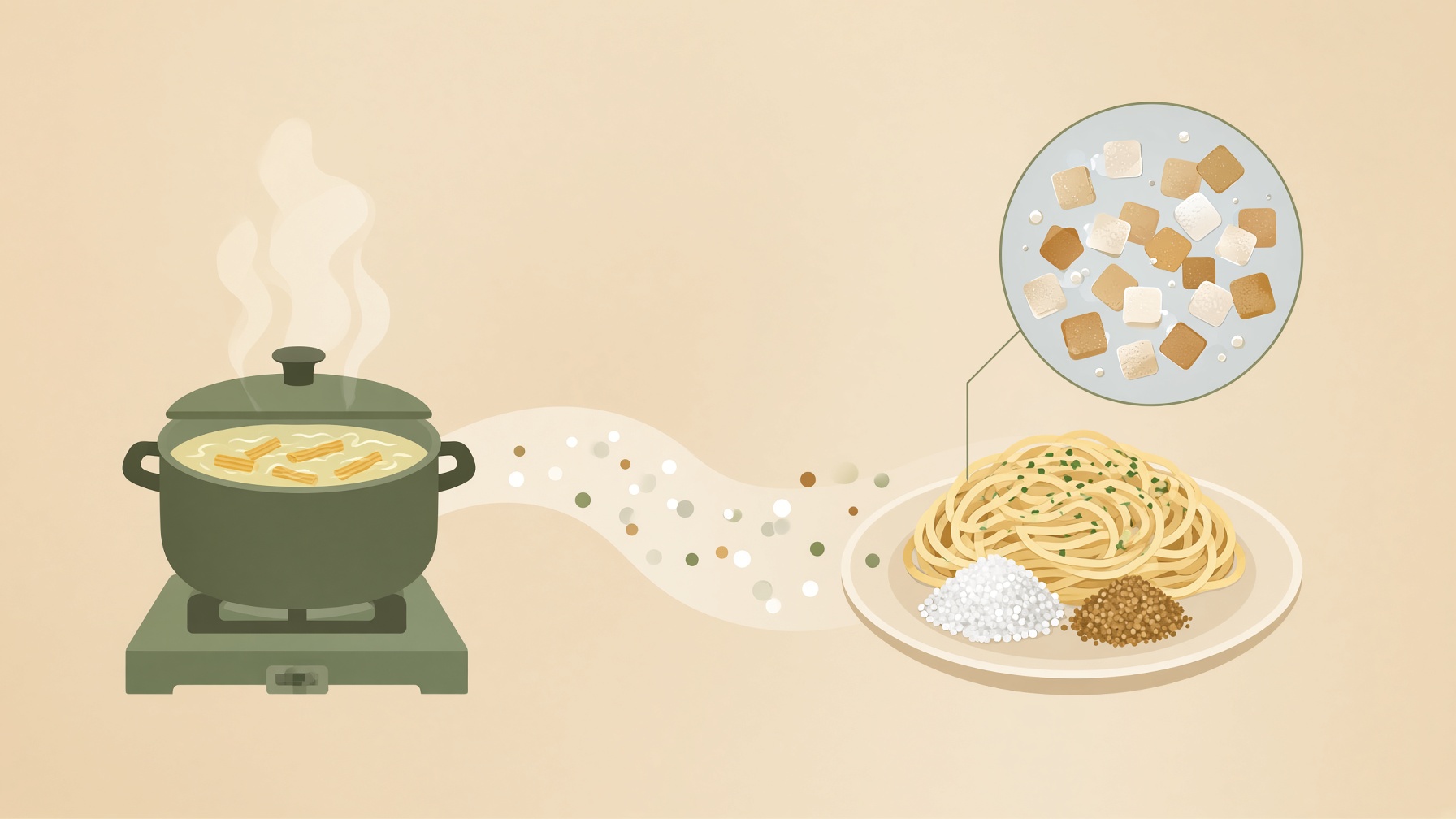
You're making pasta, and the recipe calls for a spoonful of salt in the water. As you get ready to drain the pot, you wonder how that spoonful relates to the sodium in the serving you will eat. It sounds like a simple kitchen calculation. Where would you start, though: with the amount of salt added, the amount of water in the pot, or the size of the portion on the plate? The serving is where you want the answer, even though cooking starts with a whole pot.
Two different total salt amounts produced similar measured sodium in cooked spaghetti when the batches were scaled proportionally. One preparation used 18 g of salt; the other used 9 g with half as much water and dry pasta. Both cooking waters contained 3.17 g of salt per liter. Their measured sodium was 128 and 133 mg per 140 g of cooked pasta, respectively. No statistically significant difference was detected, although that does not prove the portions were equivalent. The missing information in the salt total was how much water and pasta went with it.1
Increasing concentration while keeping pasta and water amounts fixed gave a different comparison. The reference preparation used 454 g of dry commercial semolina spaghetti and 5.678 L of water, with a nine-minute boil followed by a one-minute colander drain without rinsing or agitation. At 6.34 g of salt per liter, the drained spaghetti contained about 247 mg of sodium per 140 g cooked portion. Doubling the water's salt concentration to 12.68 g per liter produced about 490 mg of sodium on that same cooked-weight basis: approximately twice as much in this preparation.1
Grams of salt per liter describe the cooking water; milligrams of sodium per 140 g describe the drained food. Concentration helped explain the tested portion results, but was not established as the only relevant variable for every recipe. Sodium remained after draining, yet the food measurement did not establish what percentage of all the pot's salt was retained. The study therefore supplies a portion result, not a complete account of where all the added salt went.1
The question becomes more precise when the amount added to the pot and the sodium in a serving are kept separate. An answer about the serving needs a stated preparation and portion size. It does not need to become a complete account of every bit of salt in the cooking process. This gives the original kitchen question a defined scope.


Join the discussion
No account or email is required. Your display name and comment will be public.