
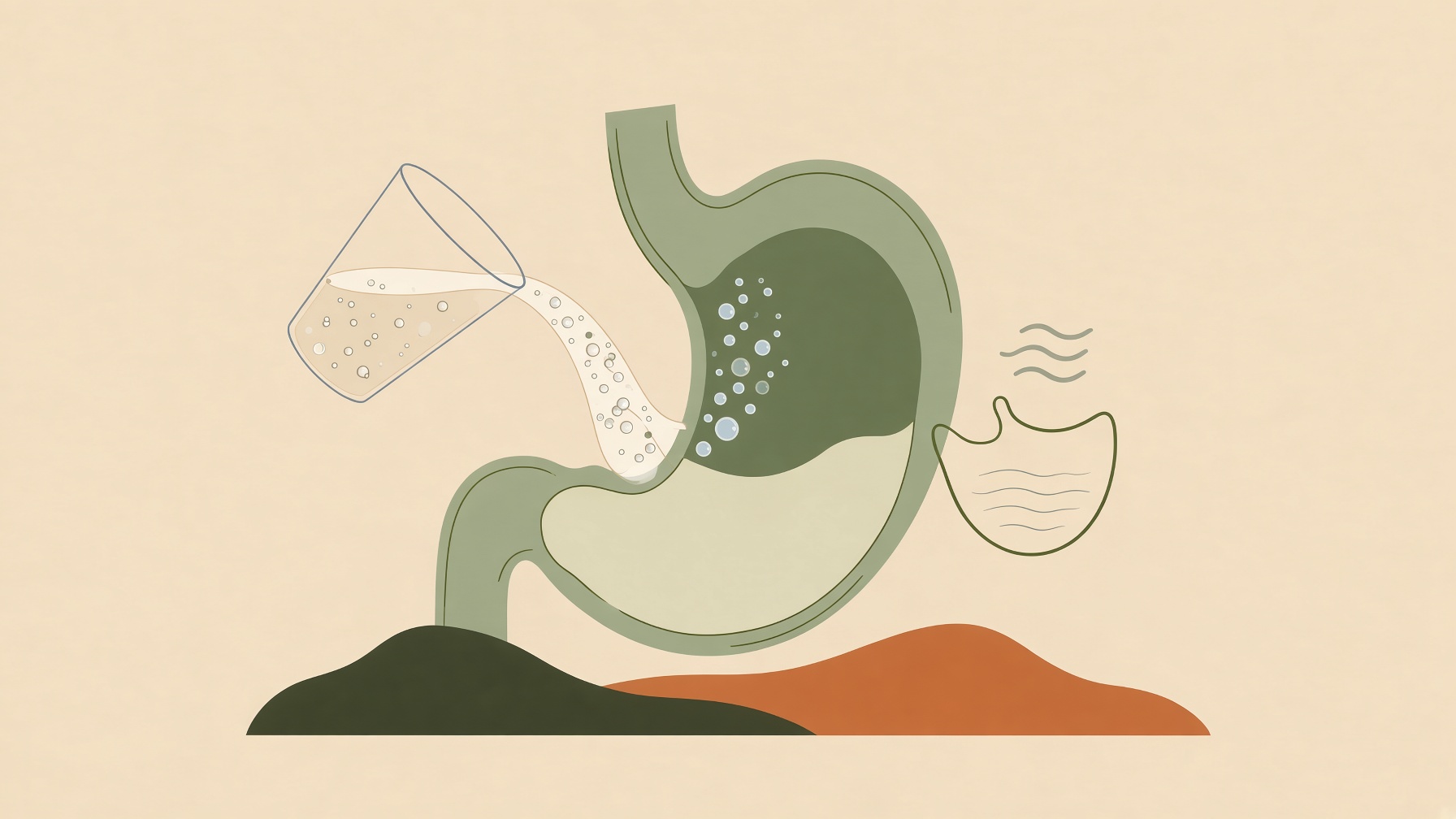
You're choosing a drink before lunch, and the fizzy option brings up a question: will there be less room for food afterward? It is easy to picture the stomach as a container with only so much space. Before turning that picture into an answer, though, what do we mean by “room”: the space inside the stomach, the feeling of being full, or the point when you put down your fork? The question starts with the drink and leads us to the meal.
The extra space in a controlled comparison came mainly from gas, rather than from drinking more liquid. Ten healthy young adults each received 300 mL of water, a non-caloric carbonated beverage and the same beverage with its gas removed, on separate visits. MRI scans immediately after drinking showed a larger increase from pre-drink stomach volume after the carbonated drink. Gas accounted for most of the extra increase. The degassed version offered the closest comparison for carbonation because water also differed from the soft drink in sweeteners and acidity.1
Occupied space and felt fullness were measured separately. Participants reported their immediate sensations on a rating scale, so the researchers did not have to assume what the scan meant to the person being scanned. The immediate satiety rating was numerically higher after carbonation, but the difference was not statistically significant. The ratings established neither a definite increase in fullness nor equal sensations across the drinks.1
Whether participants subsequently ate less required measuring the energy in the food they consumed, expressed in kilocalories. Each beverage was tested before both solid and liquid meals on separate visits. Food arrived at a prescribed rate of about 110 kcal every five minutes, and eating stopped when participants reached the maximum rating on a separate satiety scale. Food delivery was timed, although participants could choose their pace within each five-minute solid-food portion. The stopping point was not a fixed number of minutes after the drink.1
At that stopping point, no statistically significant beverage-related difference in consumed energy or total stomach volume was detected. That was the result within the solid-meal tests and, separately, within the liquid-meal tests. With only ten participants and no equivalence test, this finding could not establish that the drinks produced identical intake. The endpoint scans also did not establish where the gas went or which physiological process explained the pattern. The experiment documented the early volume increase and later intake results without identifying a causal explanation connecting them. The study was supported by The Coca-Cola Company, and one author was a company employee.1
“Less room for lunch” can mean less space in the stomach, a stronger feeling of fullness, or less food eaten. Those meanings need to be kept separate when considering the original question. A clear answer should say which one is being discussed and how it was assessed. That prevents an observation about stomach size from becoming a general promise about eating less.
Join the discussion
No account or email is required. Your display name and comment will be public.