
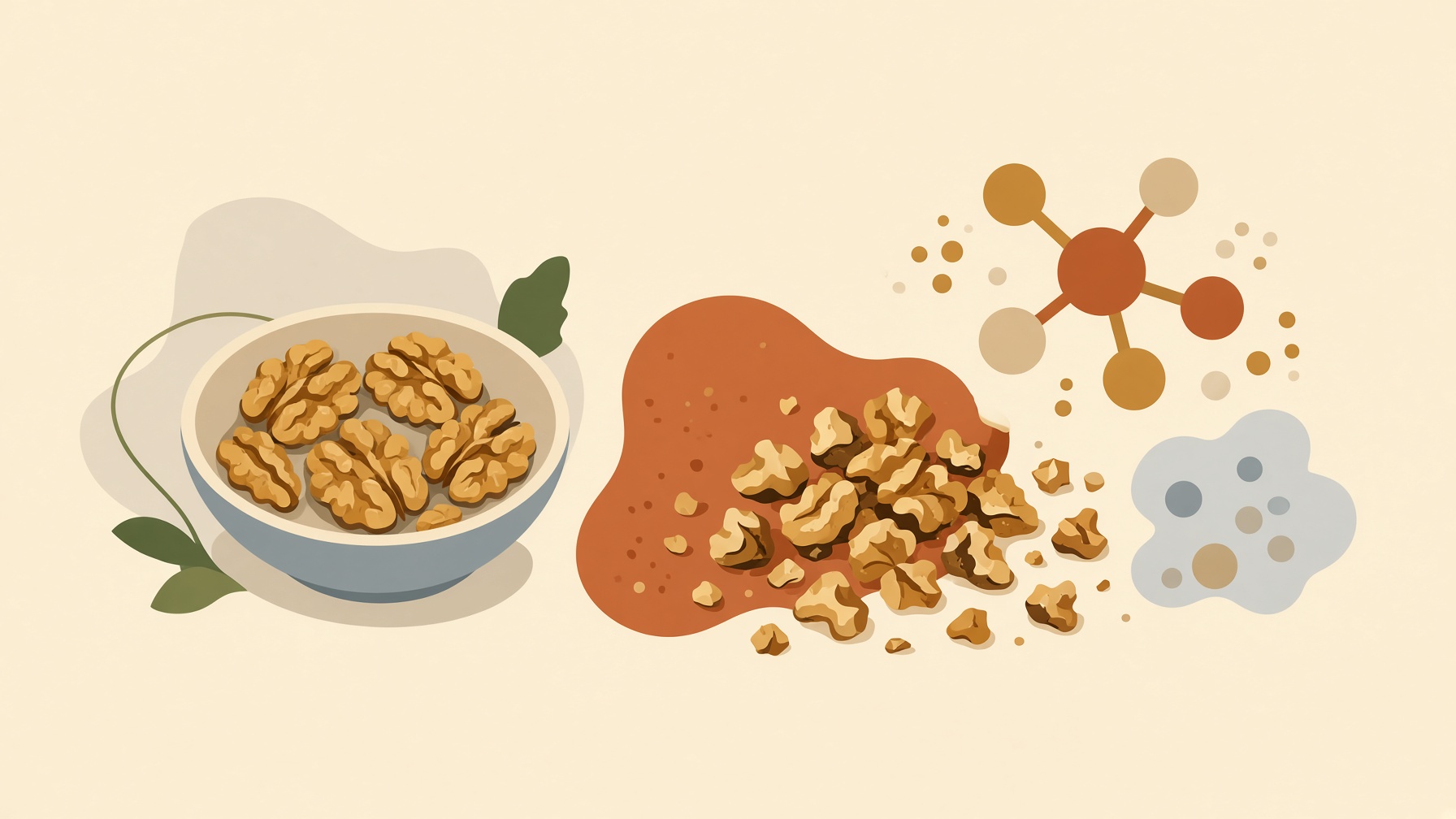
Chopping walnuts ahead of time is a small convenience, especially when they are destined for oatmeal, salads, or baking. The chopped pieces begin as the same kernels you could have kept in halves. But after those pieces have sat in storage, are the fats in them changing in the same way?
Chopped walnut kernels accumulated more peroxides late in one year-long storage experiment than shelled, unchopped halves. The walnuts came from one harvest in Kalat Naderi, Iran. Some kernels were left in halves and others cut into roughly eight pieces before storage. Both forms had already been shelled, so the comparison concerned chopping the edible kernel, rather than removing its hard shell. The halves and pieces were kept in polyethylene trays in the same cabinet.1
Researchers recorded temperature and humidity during storage, with the room temperature changing over the seasons. At intervals, they extracted oil from the stored kernels and measured its peroxide value. This tracks certain early products formed as fats oxidize, making it an indicator of one part of chemical deterioration. Sampling over time allowed a comparison of how the readings changed in the halves and chopped pieces.1
The tests did not detect a clear difference between forms at every sampled time. A difference appearing in the later readings does not establish a constant increase in oxidation speed throughout storage. The findings are also tied to a particular setting: the report did not fully describe light and oxygen exposure or how many batches were stored separately. Those gaps limit how confidently the result can be carried over to a different container or household kitchen.1
A peroxide value is not a flavor score. A separate walnut-storage study approached those questions with two kinds of measurement. Laboratory tests followed chemical markers, while a trained panel evaluated aroma and flavor in the stored samples. Asking people to judge those qualities provides a sensory assessment that the laboratory reading alone does not supply. The direct chopping comparison did not include that kind of assessment. Its chemical results therefore cannot show whether the chopped walnut kernels tasted rancid sooner.1,2
Food safety is another question the chemical readings cannot settle. The first study used a peroxide benchmark, but it was not a validated household safety cutoff. Crossing that benchmark does not establish a discard date, and staying below it does not certify that a batch is safe. The year-long observation period describes how long the experiment ran; it is not an allowance for keeping walnuts at home.1
If you're chopping walnuts ahead of time, the goal is usually to make the next meal a little easier. The comparison includes both how they're prepared and how long they'll wait before you use them. Keeping those details together is more helpful than treating “chopped” or “unchopped” as the complete answer.
Join the discussion
No account or email is required. Your display name and comment will be public.