
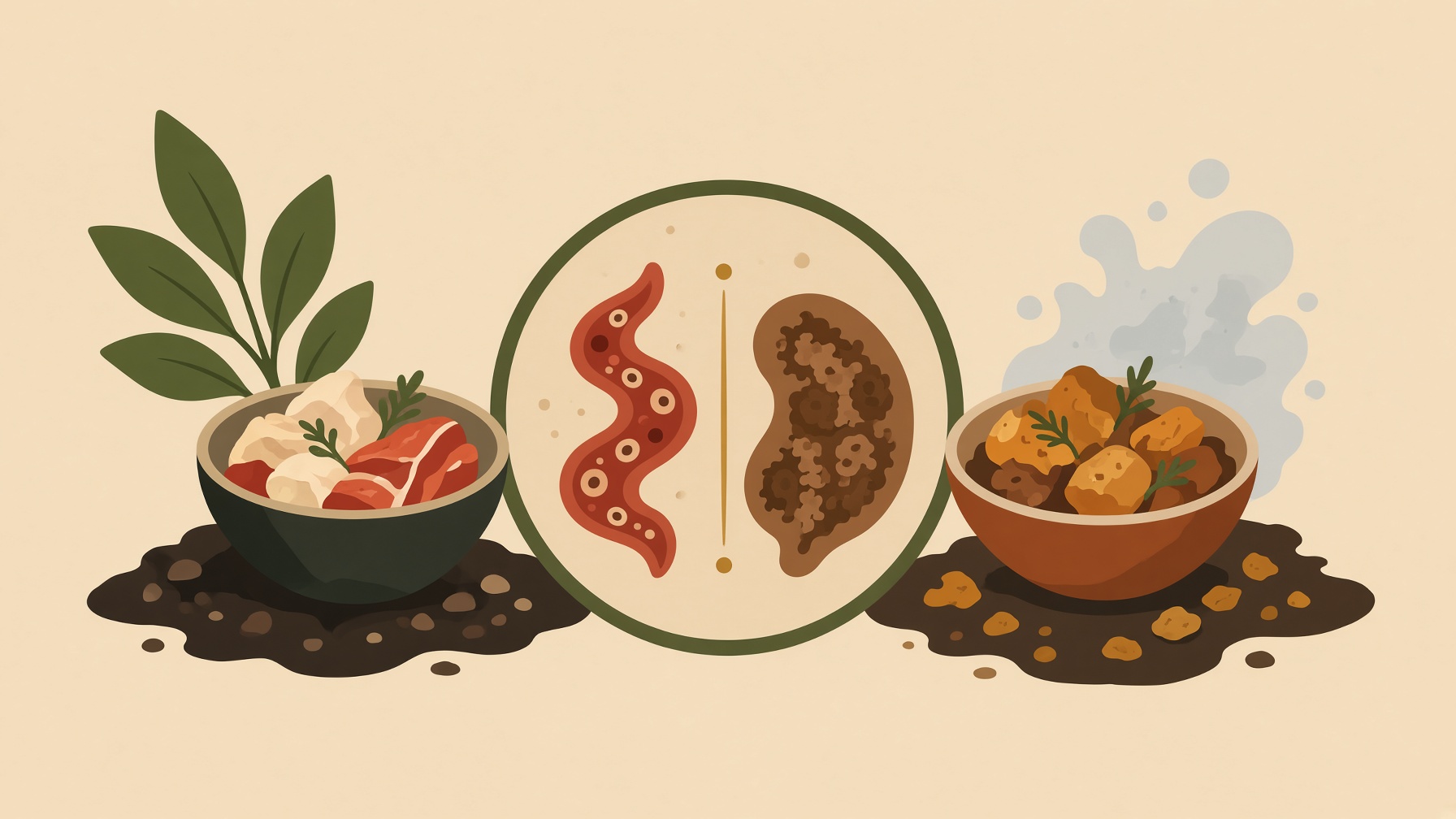
You have the same ingredients on the counter, but two different ways to cook dinner. One recipe calls for boiling or steaming, the other for grilling or baking. Which would you call the healthier meal, and what would make you confident in that answer? Before choosing a winner, it helps to pause over the word 'healthier.' Are we asking about a particular change in the body, or making a judgment about the meal as a whole?
A small trial compared boiling and steaming recipes with grilling and baking recipes using the same ingredients. The first approach was intended to generate fewer advanced glycation end products, or AGEs, compounds that can form during heating. Twenty-two healthy adults were randomized, and twenty were included in the analysis. They followed the two conditions in opposite orders, each for two weeks, and knew which cooking instructions they were following. Food could be eaten freely, so matching the supplied ingredients did not make the consumed portions experimentally identical. What was compared was a pair of preparation packages, not two precisely identical intakes differing only in AGEs.1
After boiling and steaming, blood signals for two AGEs, labeled CML and MG-H1, were lower in an analysis that combined both intervention orders. The laboratory assay reported relative signal sizes, rather than calibrated concentrations. They showed a short-term difference in these blood measurements, without directly measuring dietary AGE absorption or the amount throughout the body.1
Total cholesterol requires a different comparison. Among the nine participants who moved from the lower-generating to the higher-generating condition, total cholesterol rose by an average of 8 mg/dL. Among the eleven who followed the reverse order, it fell by an average of 7 mg/dL, but that reverse change was not statistically significant. Statistical significance in one order and not the other does not itself establish a difference between orders or a reproducible cholesterol benefit. The uncertain reverse comparison is not proof that nothing changed.1
Butyrate, one of the short-chain fatty acids produced by gut microbes, was measured in stool. It also increased significantly only in the lower-to-higher sequence; the reverse sequence did not show a significant change. That increase does not establish an advantage for the higher-generating cooking package: stool concentration does not tell us how much butyrate was produced or taken up by the body. The measurement cannot identify which process accounts for the cooking result or demonstrate a gut-health benefit. The trial did not measure whether either diet prevented disease, and the blood and stool changes cannot be combined into a net health score.1,2
Identifying an AGE-specific cause would require more than this preparation comparison. Dietary CML was estimated from a database, and this small, short, exploratory experiment did not isolate AGEs from other food properties that changed with preparation or test whether AGEs mediated the other findings. The two periods ran consecutively, without a washout interval, so effects from the first could have persisted into the second. Both intervention periods also differed from participants' habitual diets, and participants lost weight during the trial. Many analyses were exploratory and were not corrected for multiple testing, so the individual findings need confirmation.1
Calling a meal healthier requires being clear about what that judgment covers. A blood or stool measurement is one part of that assessment, rather than a verdict on the whole meal. The cooking comparison can be read without declaring one preparation universally preferable. The distinction is between evidence about a particular outcome and a broader health judgment that the evidence has not yet settled.


Join the discussion
No account or email is required. Your display name and comment will be public.