
Many metabolic reactions depend on changes that are easy to describe chemically but harder to visualize inside a cell. Molecules can change their chemical state as they interact with enzymes and other reaction partners, and those changes help drive pathways involved in extracting and using energy from nutrients. Redox chemistry provides the language for describing one of the most important kinds of change involved in that process.
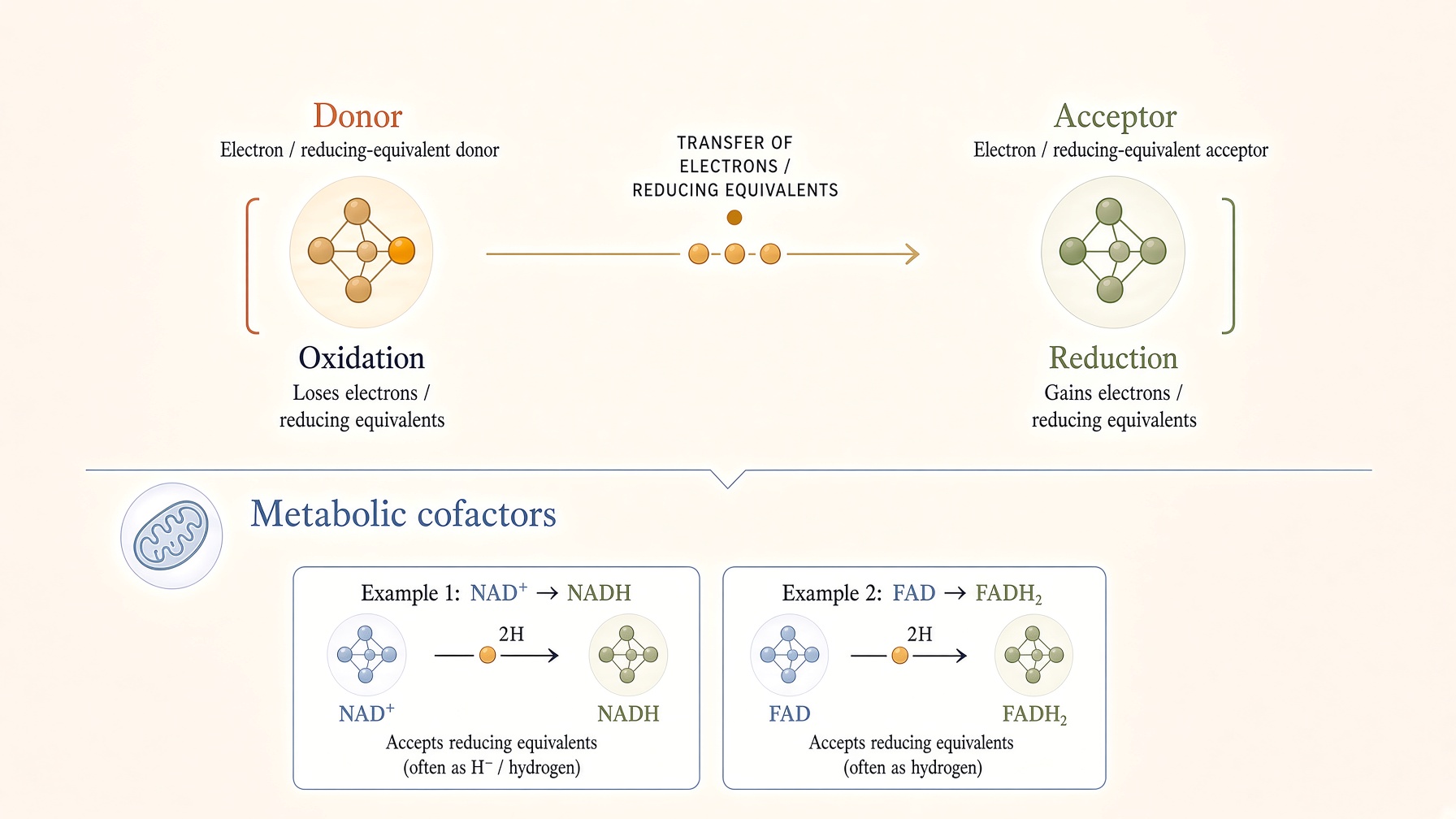
Oxidation means the loss of one or more electrons from a molecular entity, while reduction means gaining one or more electrons. In a redox reaction, those processes are coupled. If one molecule donates electrons and is oxidized, another must accept those electrons and be reduced. A common memory aid is “OIL RIG”: oxidation is loss, reduction is gain. The useful point is not the mnemonic itself, but the paired nature of the reaction .1
In metabolism, electron transfer often occurs together with the transfer of hydrogen in forms such as hydride or hydrogen atoms rather than as free electrons moving independently through solution. Many of these reactions are catalyzed by oxidoreductases, including dehydrogenases that transfer reducing equivalents from a substrate to an electron-accepting cofactor .1,2,3
Redox cofactors can accept and donate reducing equivalents during enzyme-catalyzed reactions. NAD⁺ and FAD are two important examples, although their reaction mechanisms are not identical. When NAD+ is reduced, it forms NADH; when FAD is reduced, it forms FADH2. These names identify the reduced forms of two important redox coenzymes .2,3
The importance of redox chemistry becomes clearer when it is viewed as a way of changing the chemical potential of molecules rather than simply as a vocabulary exercise about electrons. As metabolic pathways proceed, changes in oxidation state help determine where reducing power is stored and where it can be used next. Learning to recognize those changes makes many reactions in carbohydrate, fat, and energy metabolism much easier to follow.
Join the discussion
No account or email is required. Your display name and comment will be public.