
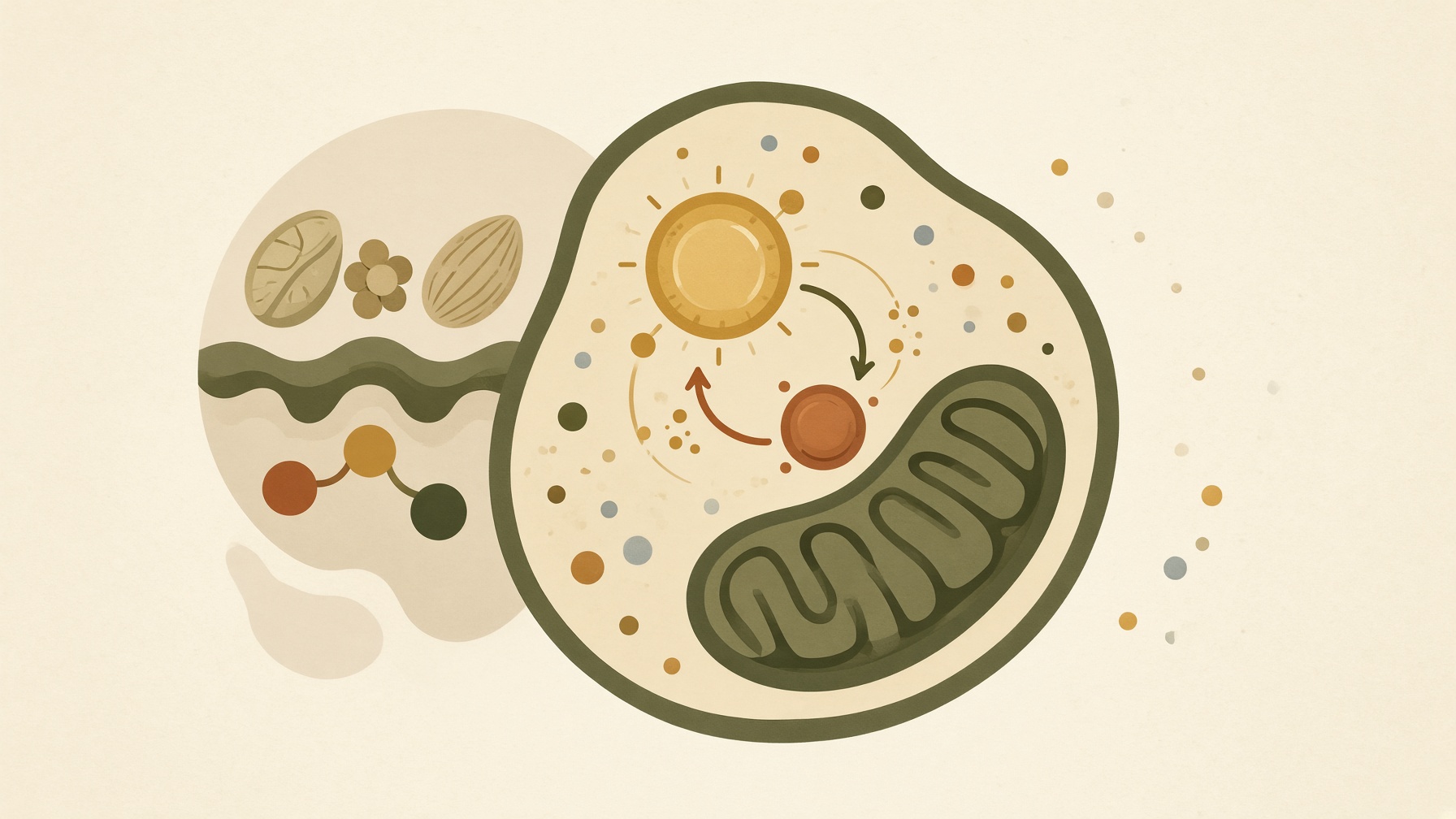
ATP, or adenosine triphosphate, is a small molecule that cells use as an immediate source of chemical energy for many forms of cellular work. Cells do not store large amounts of ATP for long-term use; instead, ATP molecules are repeatedly used and regenerated as cellular processes continue. Following what happens during that turnover helps explain why ATP functions so effectively as the cell’s immediate energy currency.
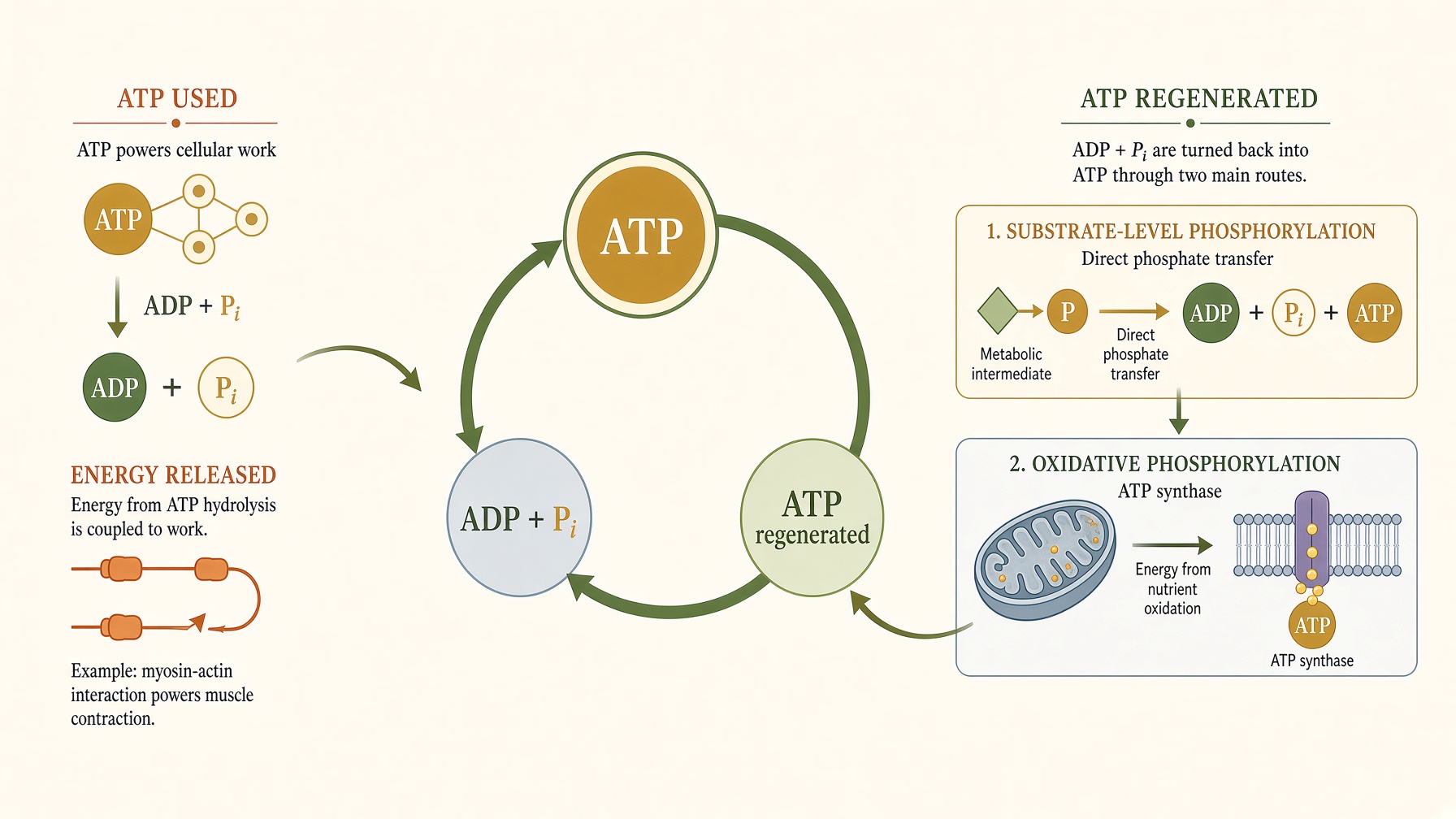
In a common ATP-hydrolysis reaction, ATP is converted to ADP and inorganic phosphate, or Pi. Under typical cellular conditions, this reaction releases Gibbs free energy. Those two facts describe different parts of the same event: ADP and Pi are the common reaction products, while the free-energy release is the energetic consequence. That free energy can then be coupled to cellular work .1
Muscle contraction provides a concrete example of energy coupling. Myosin uses ATP through its cross-bridge cycle, converting chemical free energy associated with ATP turnover into force and movement along actin. ATP binding, hydrolysis, and product release participate in different steps of that cycle rather than acting as a single instantaneous energy-release event .2
Because ATP hydrolysis continually converts ATP to lower-phosphorylated products, cells must continually regenerate the ATP they use. Cells regenerate ATP by phosphorylating ADP, but the immediate mechanism differs among pathways. Some reactions transfer a phosphoryl group directly from a metabolic intermediate, whereas oxidative phosphorylation uses ATP synthase to form ATP from ADP and inorganic phosphate. In either case, ATP regeneration ultimately depends on an available source of free energy, allowing ATP use and resynthesis to continue as an ongoing cycle .1,3
During aerobic glucose catabolism, ATP is generated principally through substrate-level phosphorylation and oxidative phosphorylation. Substrate-level phosphorylation directly forms ATP by transferring a phosphoryl group from a metabolic substrate to ADP. During complete aerobic glucose catabolism, this route produces a relatively small fraction of the ATP yield. In typical eukaryotic cells undergoing complete aerobic glucose oxidation, most ATP is instead produced through chemiosmotically driven oxidative phosphorylation. The two mechanisms therefore differ in how ATP is formed: one uses direct phosphoryl transfer from a metabolic substrate, while the other is chemiosmotically driven. This comparison applies to aerobic glucose oxidation. Cells relying on fermentation can produce ATP through substrate-level phosphorylation without oxidative phosphorylation .3
ATP is useful precisely because cells do not have to treat each molecule as a long-term energy store. Instead, a relatively small cellular ATP pool can support enormous amounts of work by being recycled again and again. The important feature is therefore not how much ATP a cell can stockpile, but how effectively metabolism can keep ATP availability matched to the processes that continually consume it.
Join the discussion
No account or email is required. Your display name and comment will be public.