
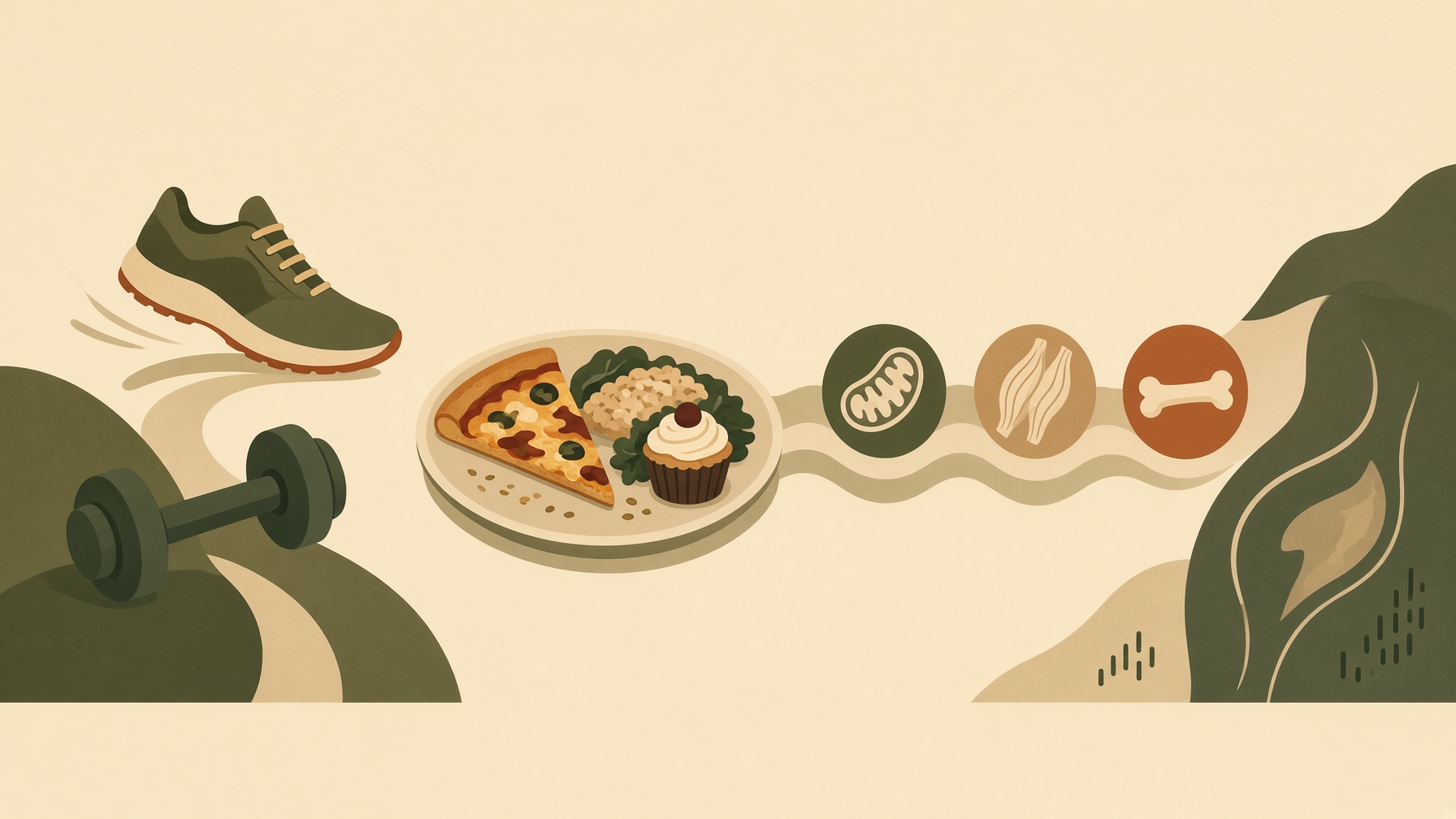
Fitness advice often turns food and training into an all-or-nothing bargain. Either you eat perfectly and take the gym seriously, or the burger, dessert, or late-night takeaway somehow cancels the work you did earlier. Real life rarely fits that neatly, which makes “Does my workout still count?” a more useful question than “Was my diet perfect?”
Research on training and nutrition generally examines repeated exercise and dietary patterns, rather than testing whether one particular meal cancels a workout. The American College of Sports Medicine’s 2026 review concluded that resistance training reliably improves strength and muscle-related outcomes in healthy adults. Training provides the stimulus for those adaptations, while nutrition can influence how well particular outcomes are supported. The two interact, but food does not operate as an on/off switch for whether a single session produces an effect.1,2,3
Protein is one example. A meta-analysis of 49 randomized trials involving 1,863 participants found modest additional gains in fat-free mass, muscle size, and strength when protein intake was increased during prolonged resistance training. The added fat-free-mass benefit appeared to level off around 1.6 grams per kilogram of body weight per day in the meta-regression, but the estimate was imprecise and is not a hard individual cutoff. The useful point is that adequate protein can support adaptation over time; it does not mean one low-protein meal erases the training stimulus.2
Energy intake shapes a different part of the outcome. A meta-analysis found that energy deficits impaired gains in lean mass during resistance training, while strength gains were not significantly different between deficit and non-deficit conditions. The researchers also modeled how larger deficits were associated with less lean-mass gain, but that estimate was a group-level relationship rather than a physiological threshold for one person. It helps explain why the same training program can produce different body-composition outcomes under different nutritional conditions.3
“Eating poorly” can also mean very different things. An occasional food chosen mainly for enjoyment is not equivalent to a dietary pattern that repeatedly fails to provide adequate energy, protein, micronutrients, fiber, or variety. FAO and WHO describe healthy diets through adequacy, balance, moderation, and diversity, leaving considerably more room for flexibility than an all-or-nothing idea of eating “perfectly.”4
Food choice still matters across the larger pattern. In a controlled NIH trial, participants ate more calories and gained weight during an ultra-processed diet phase than during an unprocessed diet phase, even though the menus were designed to be comparable in several nutritional characteristics. The experiment was small and short and does not mean every processed food behaves the same way. It shows that the foods surrounding a person can influence spontaneous energy intake.5
Health outcomes extend beyond muscle and body weight too. Observational research in tens of thousands of adults has linked both higher diet quality and greater physical activity with lower mortality risk. Because that evidence is observational, it cannot prove cause and effect or show that the two behaviors multiply each other’s benefits. It does reinforce the broader point that nutrition and activity matter as patterns over time.6
The evidence therefore supports looking at training and nutrition on the timescale where they actually operate. Exercise provides repeated stimuli; protein, energy balance, and overall diet quality influence the environment in which adaptations and health outcomes develop. None of that provides a scientific basis for treating one imperfect meal as a cancellation button.1,2,3,4,5,6
There is plenty of space between eating like a fitness advertisement and abandoning the idea of nutrition altogether. Food and exercise can remain two parts of the same life, each worth attention without requiring the other to be flawless.


Join the discussion
No account or email is required. Your display name and comment will be public.