
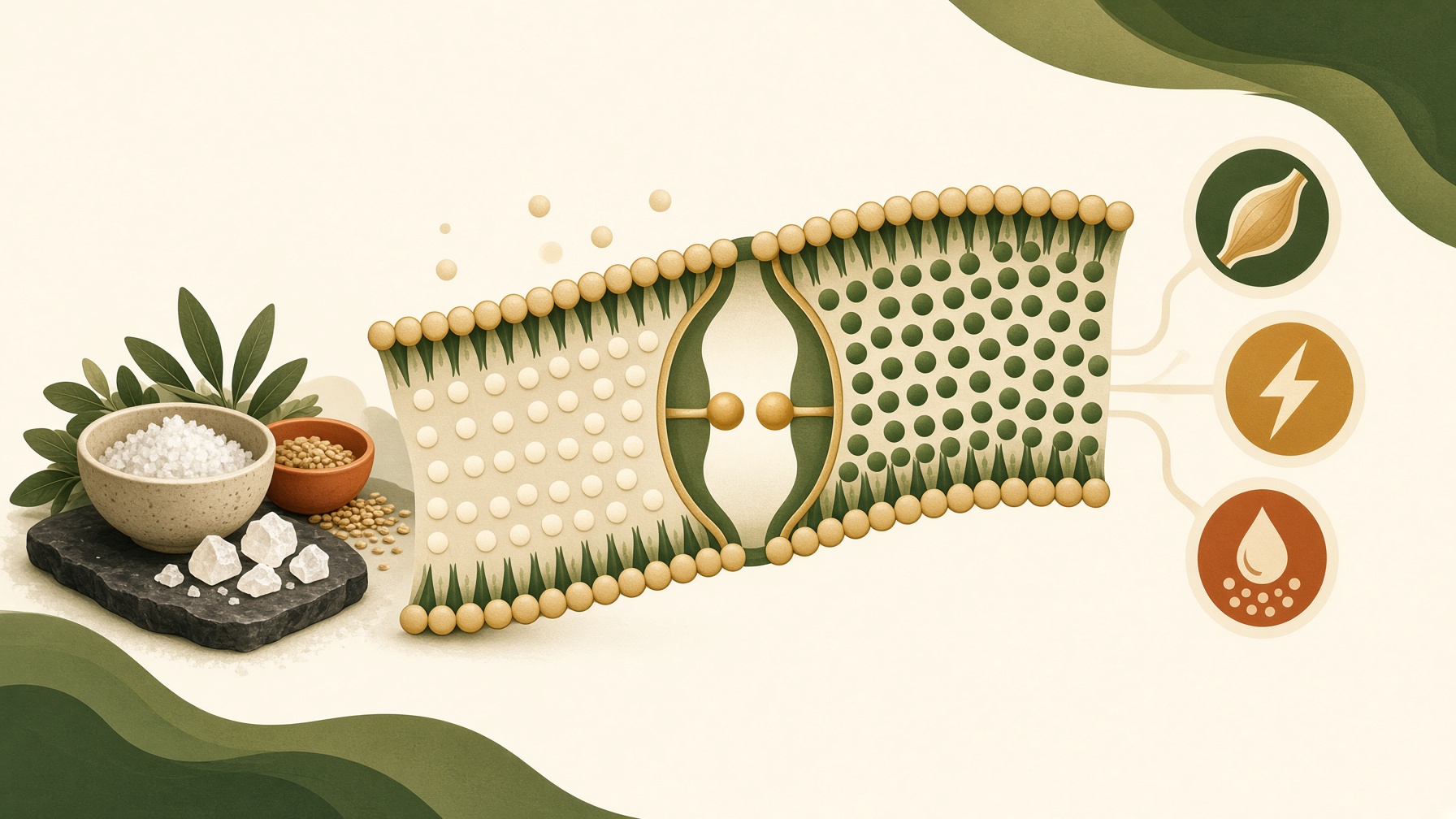
Sodium is usually introduced as an electrolyte involved in body-fluid balance, but that description leaves out much of what makes the ion physiologically important. Its unequal distribution across cell membranes creates conditions that cells can use for several different kinds of work. Looking at those membrane-level roles gives a much broader picture of what sodium actually does in the body.
Sodium is the major cation in extracellular fluid, and together with accompanying anions it makes a large contribution to extracellular fluid osmolality. A steep sodium concentration gradient also exists across many cell membranes, with sodium concentration much higher outside cells than inside. Cells maintain that gradient largely through the sodium-potassium pump, and many physiological processes make use of it .1
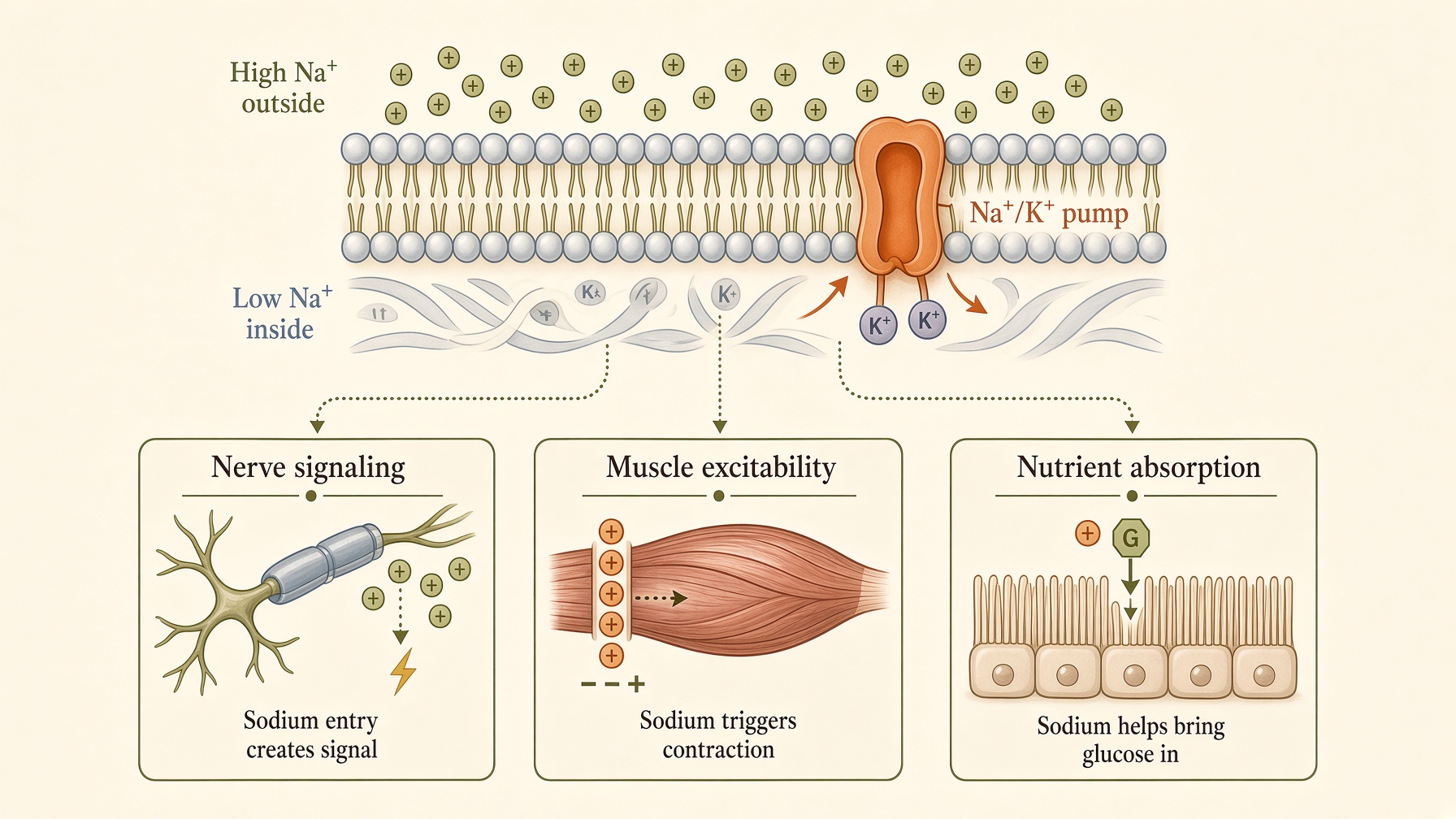
In the nervous system, sodium is essential for the normal generation and conduction of neuronal action potentials. During an action potential, voltage-gated sodium channels open and sodium ions enter the neuron. This inward movement drives depolarization, a change in membrane voltage that forms part of the electrical event. Sodium therefore has a direct role in the electrical signaling that allows neurons to generate and conduct action potentials. That role depends on controlled ion movement across the cell membrane .1
Sodium also has a direct role in skeletal-muscle excitability. Opening of voltage-gated sodium channels produces the rapid depolarizing phase of the muscle-fiber action potential, which then propagates along the sarcolemma and into the T-tubule system to initiate excitation-contraction coupling .1
The small intestine shows another use for sodium gradients. They are essential for the absorption of glucose, galactose, and several amino acids, although not every nutrient depends on sodium in this way. The gradient itself is maintained by the sodium-potassium pump. The basolateral sodium-potassium pump uses ATP directly to move sodium out of enterocytes and potassium into them, helping keep intracellular sodium relatively low. That sodium gradient then provides the energy for secondary active transporters such as SGLT1, which cotransports sodium with glucose or galactose across the apical membrane .1,2
Sodium becomes easier to understand when it is viewed not simply as something the body “contains,” but as an ion whose location matters. Keeping sodium unevenly distributed across cell membranes creates stored electrochemical potential that cells can repeatedly use. That underlying principle helps explain why the same ion can participate in processes that look very different on the surface.

Join the discussion
No account or email is required. Your display name and comment will be public.