

When people talk about the core, the image is usually familiar: abs, planks, crunches, perhaps a strong lower back. That definition makes training easy to visualize. It also leaves one part of the system almost completely out of sight.
Anatomically, the core extends beyond the abdominal muscles. One commonly used model describes it as an anatomical box formed by the abdominal and spinal muscles around the trunk, the diaphragm above, and the pelvic floor below. The pelvic floor is therefore not a separate add-on to the core; it is part of the broader muscular system involved in supporting and controlling the trunk.1
Female and male pelvic floors share the same broad purpose, but their anatomy is not identical. Research has described differences in pelvic-floor shape and geometry, while the female pelvic floor also contributes to support and closure around the urogenital opening through an interaction of muscle, connective tissue, and neuromotor control. These differences do not make the female core inherently weaker; they simply mean that the structures and demands are not identical.2,3
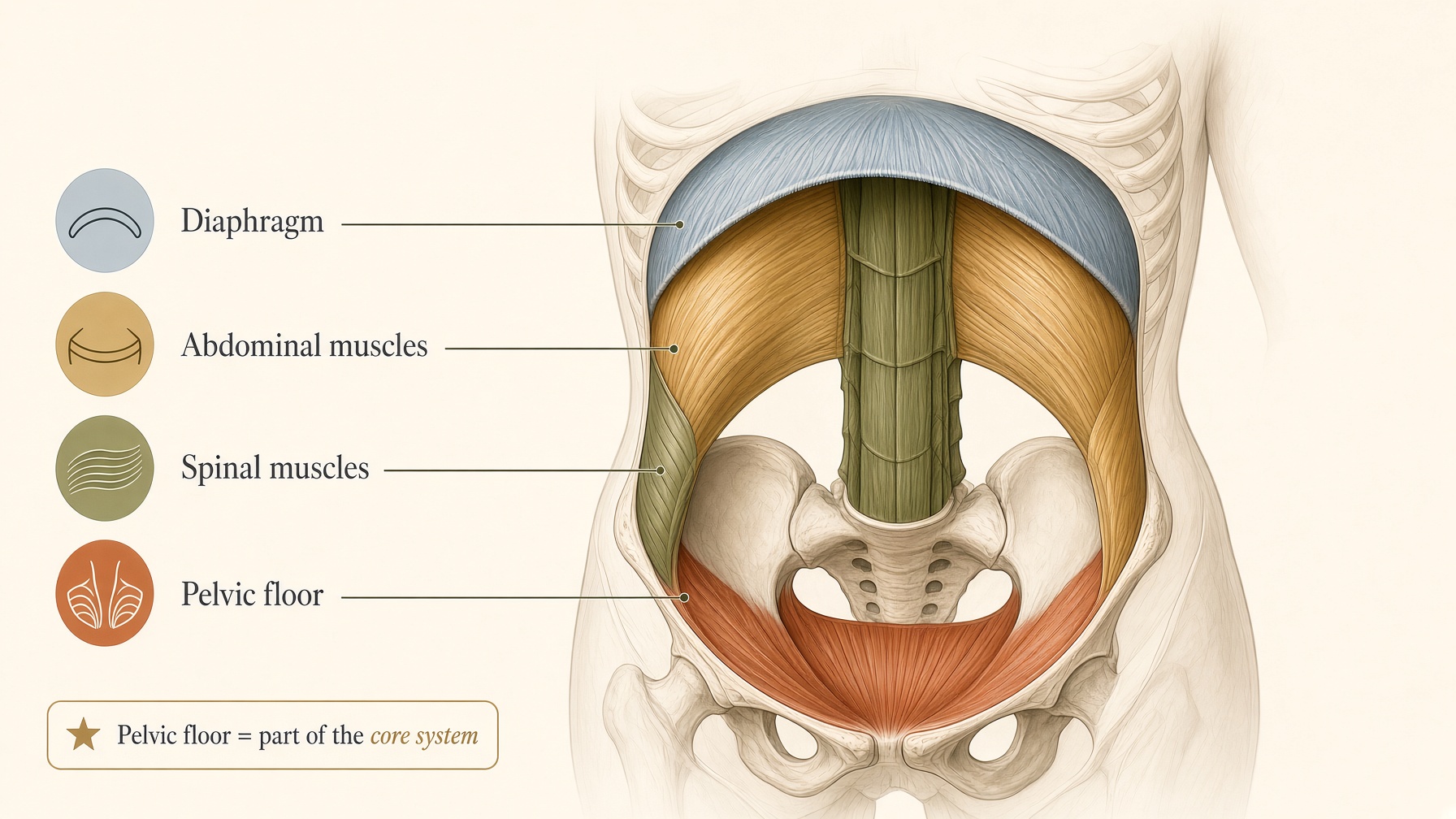
Exercise changes the forces moving through this system, but those forces are difficult to reduce to a single “safe” or “unsafe” pressure number. A 2026 review found substantial variation in how intra-abdominal pressure is measured during physical activity, and a recorded pressure does not necessarily represent the load experienced by one specific pelvic-floor tissue. That makes blanket claims about particular exercises harder to support than they may sound.4
Pelvic-floor symptoms are also not confined to people who are otherwise physically weak. An umbrella review of studies in female athletes estimated that urinary incontinence was common across the included cohorts, although prevalence varied widely. Higher training volume was associated with higher odds in some analyses, but the evidence was mainly observational and broad labels such as “high impact” did not reliably explain who developed symptoms. Strong legs, visible abdominal muscles, and high athletic performance therefore do not rule out urinary leakage during exercise.5
Targeted pelvic-floor muscle training can help when urinary leakage and impaired pelvic-floor function are part of the problem. Research in young female athletes and recreationally active women has found improvements in pelvic-floor strength and urinary leakage with training. Importantly, clinical guidance treats pelvic-floor training as more than repeated squeezing: depending on the person, it can involve strength, endurance, power, coordination, and the ability to relax.6,7
A definition of the core is not, by itself, a prescription for a particular exercise routine. When symptoms such as urinary leakage are present, assessment can help identify what a supervised pelvic-floor program should actually address rather than assuming the answer is simply “more core work.”1,7
The muscles we notice most easily are usually the ones we can see in a mirror. A conversation about the core can leave room for the less visible parts too, especially when someone has a question they have felt reluctant to ask.


Join the discussion
No account or email is required. Your display name and comment will be public.