
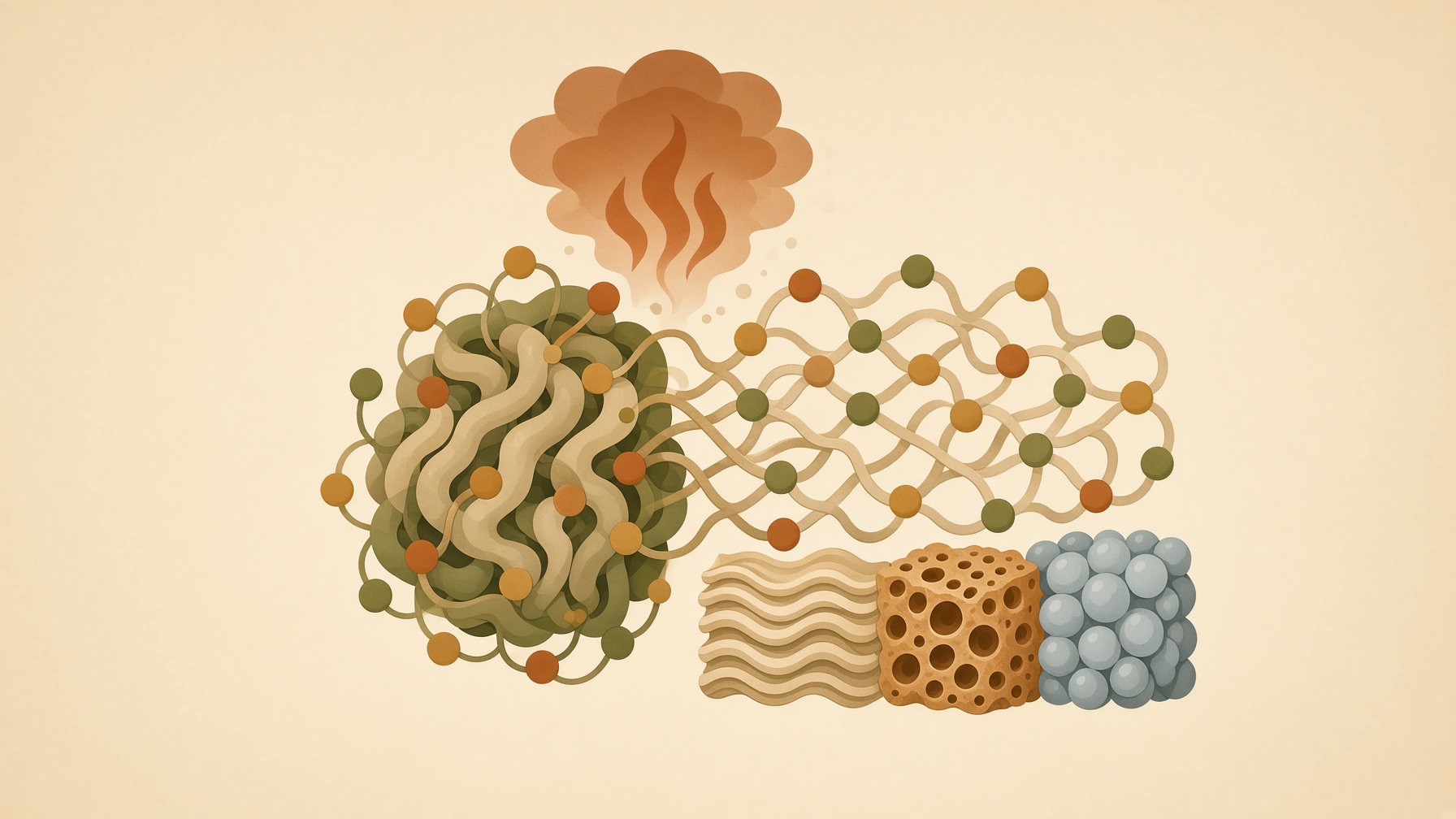
Protein denaturation is often described as “unfolding,” which can make the process sound more absolute than it is. Cooking offers a useful way to see what actually changes in a protein, and what usually stays intact.
Denaturation is an alteration or loss of a protein’s native higher-order conformation. During cake baking, for example, heat denatures proteins in the batter and can contribute to protein-network formation as the cake structure sets. The key change is structural: the protein no longer retains the same native folded arrangement it had before heating. Denaturation is therefore more specific than simply calling any physical change in a protein “denaturation” .1,2
Heat can cause that change by disrupting noncovalent interactions that help stabilize a protein’s folded structure. The resulting loss of native conformation can be partial or extensive, but denaturation does not require every protein to unfold completely into a single extended chain. Under ordinary cooking conditions, the peptide bonds that make up the protein’s primary structure generally remain intact. In other words, heat can alter higher-order folding without normally cutting the protein backbone into separate amino acids .1,3
Denaturation can also set up another change that matters in food structure. Denatured or partially unfolded proteins can associate with one another, forming aggregates or protein networks. That outcome is not inevitable every time a protein denatures. Whether aggregation occurs, and what kind of network forms, depends on the protein and on conditions such as protein concentration, pH, ionic strength, temperature, and the presence of other food components .2,3,4
The important distinction is between changing a protein’s shape and destroying its chemical identity. Cooking can substantially reorganize how a protein is folded and how it interacts with neighboring molecules without simply reducing it to its component amino acids. That difference is what makes denaturation such a useful concept for understanding the dramatic textural changes that heat can produce in foods.
Join the discussion
No account or email is required. Your display name and comment will be public.