

Suppose you stop eating wheat-containing foods and feel better. It's understandable to want a name for whatever was bothering you, especially if you're trying to make sense of an uncomfortable meal. Gluten might be the first explanation you consider. But how would you check that explanation? Before deciding what to call the problem, you can ask what changed on the plate and what kind of comparison could help explain the difference.
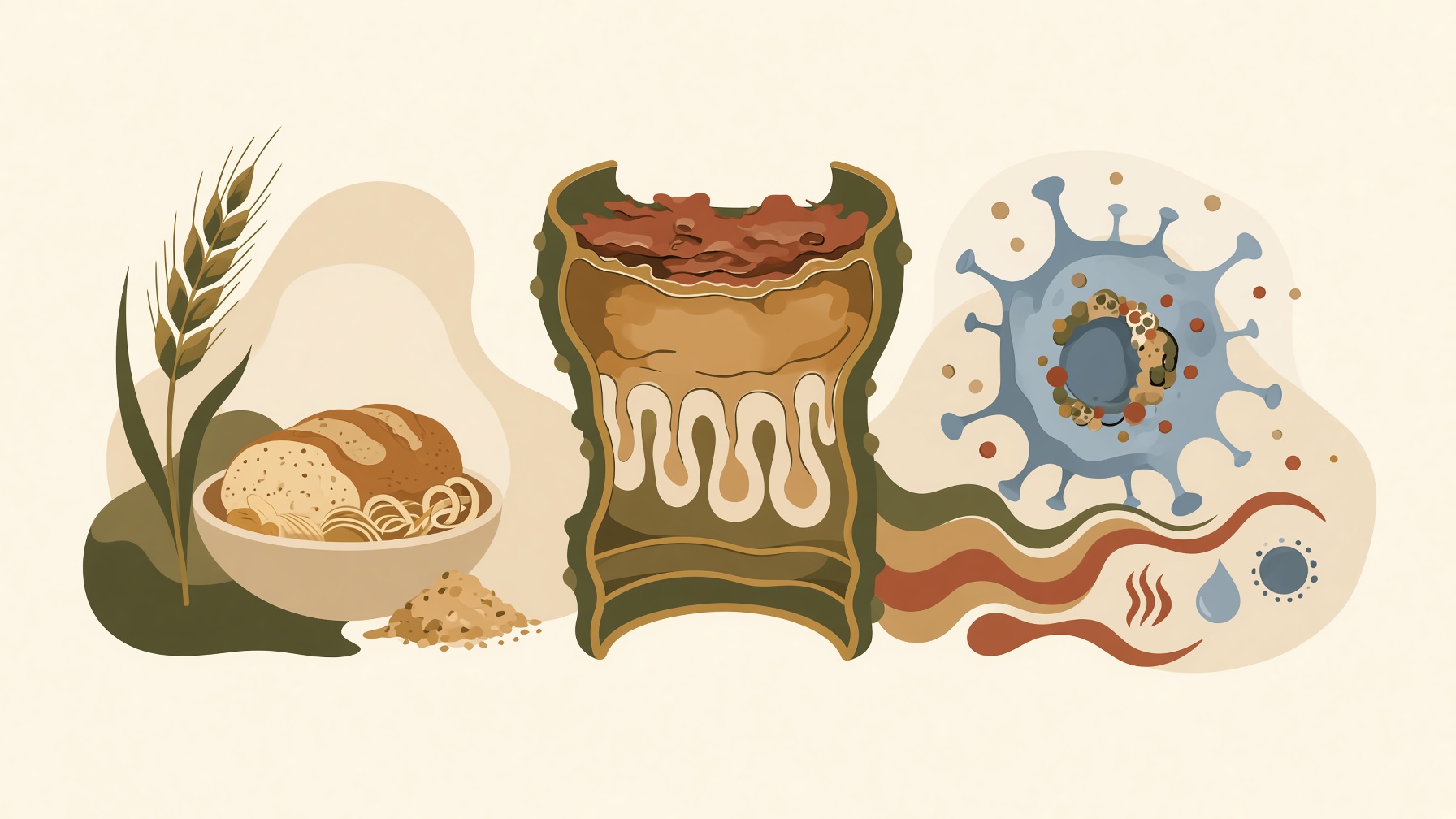
Wheat supplies both gluten proteins and fructans, a group of carbohydrates. Removing wheat-containing foods, then replacing them with other foods, changes a bundle of exposures. An improvement after that change cannot by itself identify either gluten or fructans as the cause. Wheat avoidance is also different from a broader gluten-free diet, and fructans occur in foods beyond wheat. The observation concerns the dietary change as a whole; assigning it to one component requires separating that component from the others.1
Separated challenges make that distinction more testable. Fifty-nine adults who reported gluten sensitivity were analyzed after receiving gluten, added fructan, and placebo in bars during three planned seven-day periods. Some stopped a challenge early. They had reported improvement after following a gluten-free diet for at least six months; celiac disease and wheat allergy were excluded. Each participant received all three conditions in a randomized, double-blind crossover comparison, with neither participants nor researchers knowing the assigned condition during testing. Washouts lasted at least seven days and required a return to baseline. This allowed comparisons within the same people, including against a bar without the added test components. The later microbiome report describes the same trial, rather than an independent replication.1,2
The components were more clearly separated than in whole-food removal, but the comparison was not identical to eating or avoiding wheat. The fructan challenge used added fructooligosaccharides, a type of fructan from chicory roots, rather than intact wheat. The bar recipes also differed in ingredients and nutrient composition, including protein and carbohydrate. Participants were intended to maintain their usual gluten-free diets, but the background diet was not fully controlled and adherence during challenges was not reassessed with the baseline dietary assessment.1,2
The main symptom analysis used a thirteen-item questionnaire covering the preceding seven days, rather than a tissue-injury test or diagnostic marker. Mean scores were 38.6 with fructan, 33.1 with gluten, and 34.3 with placebo. After correction for multiple comparisons, fructan scored higher than gluten, while neither comparison with placebo was statistically significant. However, a separate paired analysis of differences from placebo did find a significant fructan-placebo difference. The result therefore depends on the analysis: it would be incomplete to say that the paper found no fructan-placebo signal. Neither analysis identifies the cause of any particular reader's symptoms, and an undetected gluten-placebo difference does not prove equivalence or harmlessness.1
Each condition was given only once, so a person's highest symptom score in one period did not establish a repeatable component-specific response. Symptoms during placebo also cannot be dismissed as imagined. The comparison concerns group-level responses in selected adults over short challenges.1,2
A response to changing a diet and an explanation for that response are different questions. It is possible to describe the first clearly while remaining uncertain about the second. Naming gluten or fructans as the cause requires a comparison that separates their effects. Keeping that distinction clear avoids turning an account of feeling better into a more specific conclusion than the evidence supports.

Join the discussion
No account or email is required. Your display name and comment will be public.