

Dietary fiber is often described simply as the part of food that humans cannot digest. That description is useful, but incomplete. Reaching the end of the small intestine without being broken down by human enzymes does not necessarily mean a food component has reached the end of its metabolic story.
Human digestive enzymes cannot hydrolyze many of the chemical linkages found in dietary fiber. As a result, much dietary fiber passes through the small intestine without being broken down by those enzymes. That resistance does not mean every fiber remains unchanged all the way through the digestive tract, because microbial enzymes in the colon can act on substrates that human enzymes cannot .1
When nondigestible carbohydrate reaches the colon, microbes can ferment some of it. Many dietary fibers are fermentable, but not all are, and even when fermentation occurs, a fiber is not necessarily completely broken down. Other carbohydrates that escape digestion in the small intestine can also become substrates for colonic fermentation. The colon therefore adds a microbial stage of carbohydrate metabolism that human digestive enzymes cannot perform on their own .1
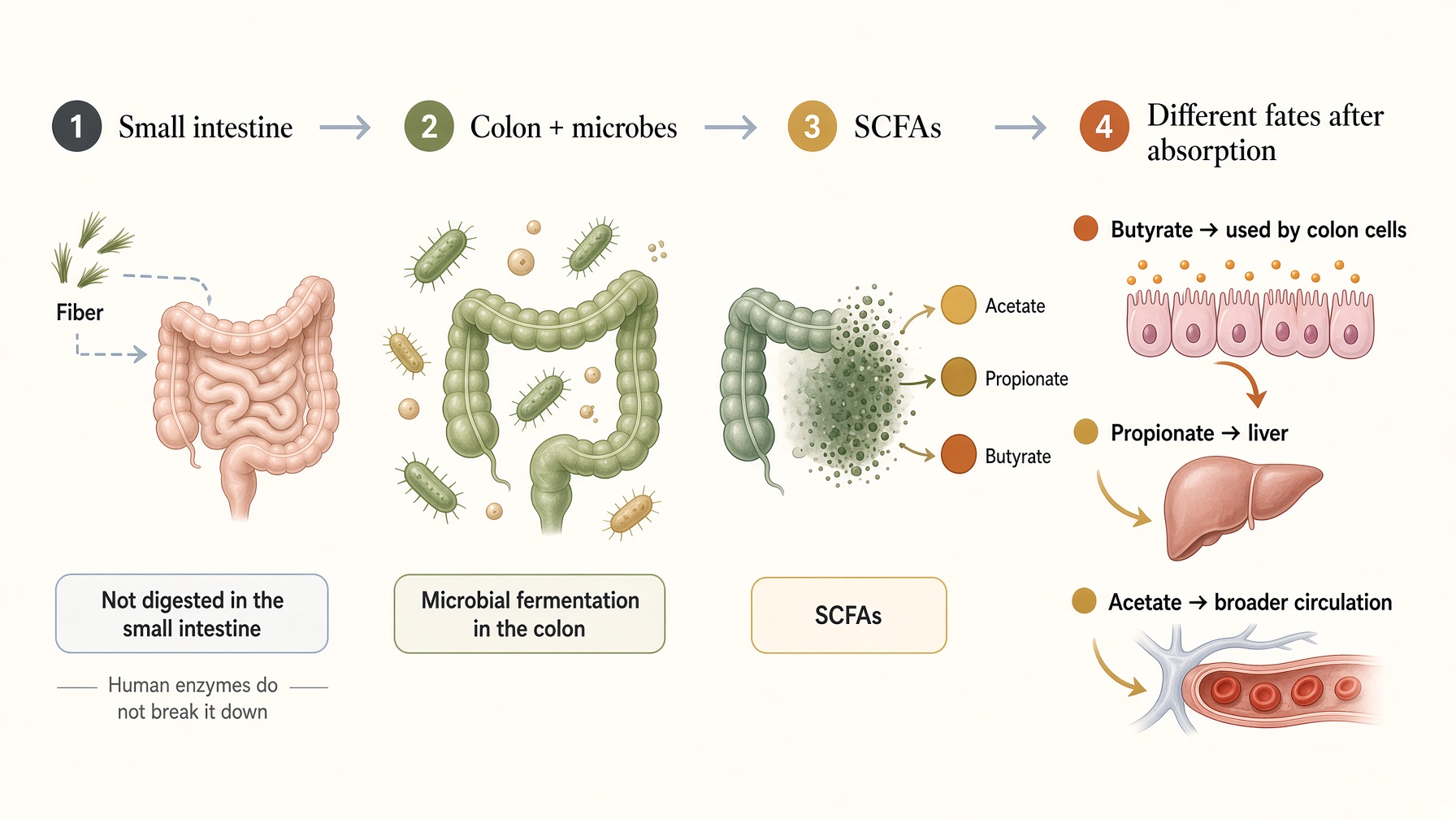
Colonic fermentation produces short-chain fatty acids, principally acetate, propionate, and butyrate, as well as gases. Most of these short-chain fatty acids are absorbed across the colonic epithelium, while only a small fraction is lost in the feces. Their metabolic fates differ after absorption; much of the butyrate is used locally by colonocytes, whereas propionate is largely taken up by the liver and acetate can circulate more widely through the body. In this way, microbial fermentation can transform some material that escaped small-intestinal digestion into compounds that are subsequently absorbed and metabolized .1,2
Microbial fermentation also means that dietary fiber is not necessarily metabolically energy-free. A commonly used average energy factor for fiber is about 2 kilocalories per gram, reflecting the recovery of some energy through microbial fermentation and absorption of its products. This value is an approximation rather than a universal physiological value for every fiber. Actual metabolizable energy varies considerably with fiber type, fermentability, and the products formed during fermentation .1
Fiber therefore sits in an unusual position between human digestion and microbial metabolism. A substance can resist the enzymes encoded by the human body yet still become biologically active once it reaches a microbial community equipped with a different set of enzymes. That partnership is one reason the nutritional effects of fiber depend not only on what the food contains, but also on what happens to it after it reaches the large intestine.

Join the discussion
No account or email is required. Your display name and comment will be public.