
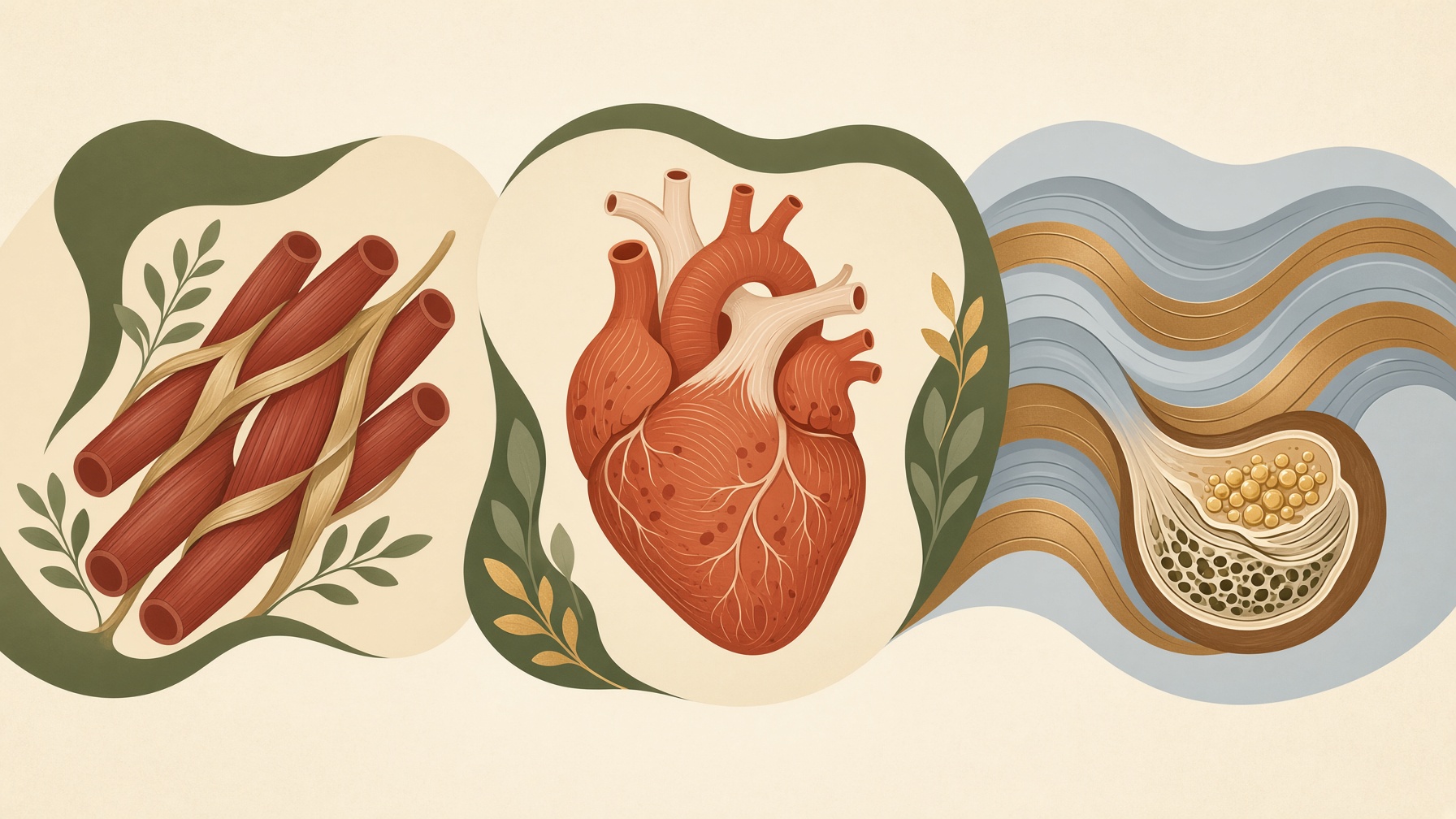
The muscles that move your limbs, keep your heart beating, and help push food through the digestive tract all belong to the same general tissue family, yet they are specialized for very different tasks. Some are under conscious control, while others work automatically without deliberate effort. These differences are reflected not only in what each muscle type does, but also in how its cells are built and organized. Looking at skeletal, cardiac, and smooth muscle side by side makes it easier to see how structure, control, and function are closely connected.
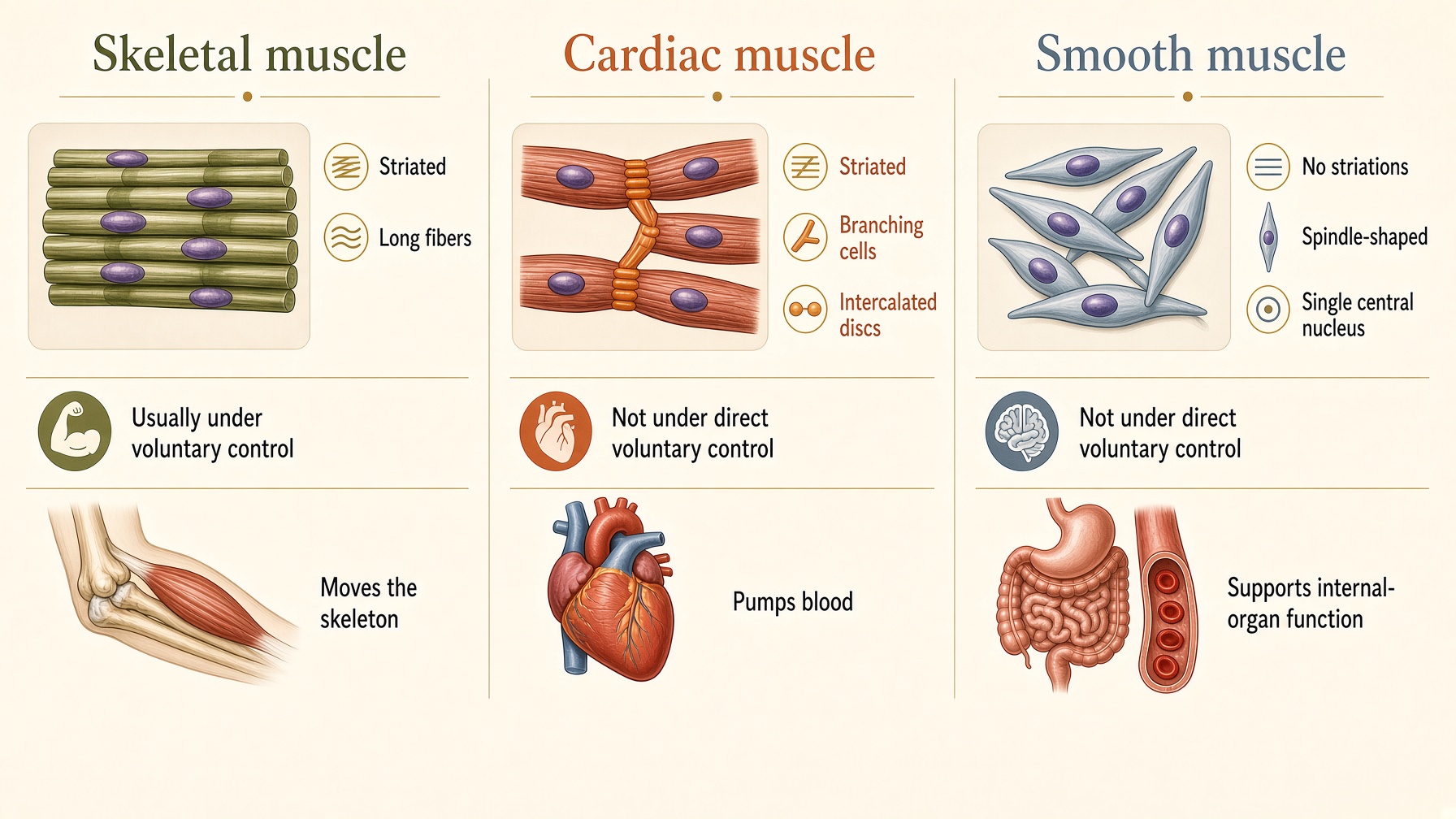
Human muscle tissue is classified into three main types: skeletal, cardiac, and smooth muscle. Most skeletal muscles attach to bones either directly or through tendons. Their contractions enable many of the body’s voluntary movements, although some skeletal-muscle actions are reflexive or automatic rather than consciously initiated. Under light microscopy, skeletal-muscle fibers have a striated appearance .1
Cardiac muscle is also striated, but it differs from skeletal muscle in both organization and function. Its cells, called cardiomyocytes, connect with neighboring cardiomyocytes at specialized structures called intercalated discs. Contraction of cardiac muscle drives the heart’s pumping of blood through the circulation, and cardiac muscle is not under direct voluntary control .1
Smooth muscle looks quite different under the microscope. Its cells are typically spindle-shaped, contain a single central nucleus, and lack visible striations. Functionally, smooth-muscle contraction produces many involuntary movements and changes within internal organs. The digestive system provides one example, where smooth muscle helps move material through the digestive tract .1
Although all three muscle types share the ability to contract and generate force, each is adapted to meet a different demand in the body. Each type is organized in a way that suits the job it performs. This is why muscle tissue cannot be understood simply as one uniform system. Comparing the three types shows how the same basic ability to contract can be modified in very different ways to support movement, circulation, and the activity of internal organs.
Join the discussion
No account or email is required. Your display name and comment will be public.