
Exercise is often explained as though the body moves through a neat sequence of energy systems: one starts the effort, another takes over, and aerobic metabolism eventually arrives for longer activity. That picture is convenient, but it is too rigid. A better model is overlapping contribution, with several ATP-producing pathways working together while their relative importance shifts as the demands of exercise change.
ATP is the immediate chemical energy source for skeletal-muscle contraction, and exercising muscle must continually meet its ATP demand. It does so through coordinated contributions from phosphagen, glycolytic, and oxidative pathways. Aerobic and anaerobic ATP production therefore occur simultaneously during exercise .1
That overlap is apparent from the first moments of exercise. Skeletal-muscle ATP demand rises immediately when activity begins. Muscle contains a small store of ATP that can support the opening moments of contraction, while phosphocreatine can rapidly donate a phosphate to ADP through creatine kinase to regenerate ATP. Phosphagen and glycolytic pathways can both resynthesize ATP quickly, making rapid nonoxidative production important when demand suddenly rises. Oxidative ATP production also begins increasing from exercise onset, but its rate rises more gradually than the sudden increase in ATP demand. During this transition, phosphocreatine breakdown and glycolysis help cover the temporary gap between ATP demand and oxidative ATP supply .1
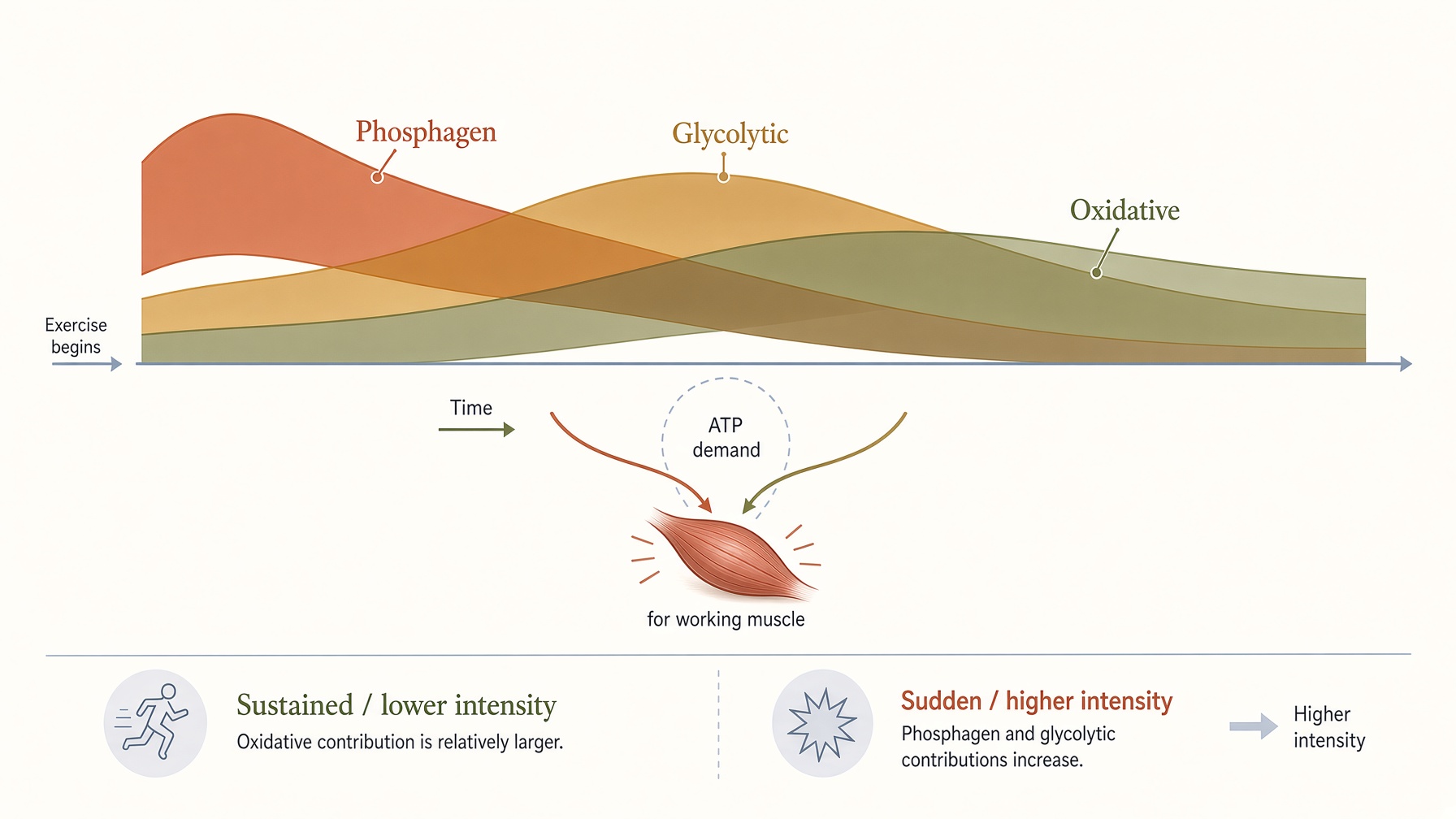
As exercise intensity and the required rate of ATP turnover rise, rapidly responding nonoxidative pathways generally make a larger relative contribution, particularly during transitions and short, intense efforts.
Intensity changes the mixture again. As exercise intensity and ATP demand rise, rapid nonoxidative pathways generally make a larger relative contribution. High-intensity exercise still draws on both anaerobic and aerobic ATP-producing pathways, and the balance between them depends strongly on how long the effort continues. Intensity therefore shifts the proportions rather than creating an all-or-nothing divide between “aerobic exercise” and “anaerobic exercise”.1
The useful shift in thinking is from asking which energy system is “on” to asking which pathways are contributing most at a given moment. Muscle metabolism continuously adjusts the mix of ATP supply to match changing demands, so exercise intensity and duration alter proportions rather than flipping metabolic switches.

Join the discussion
No account or email is required. Your display name and comment will be public.