
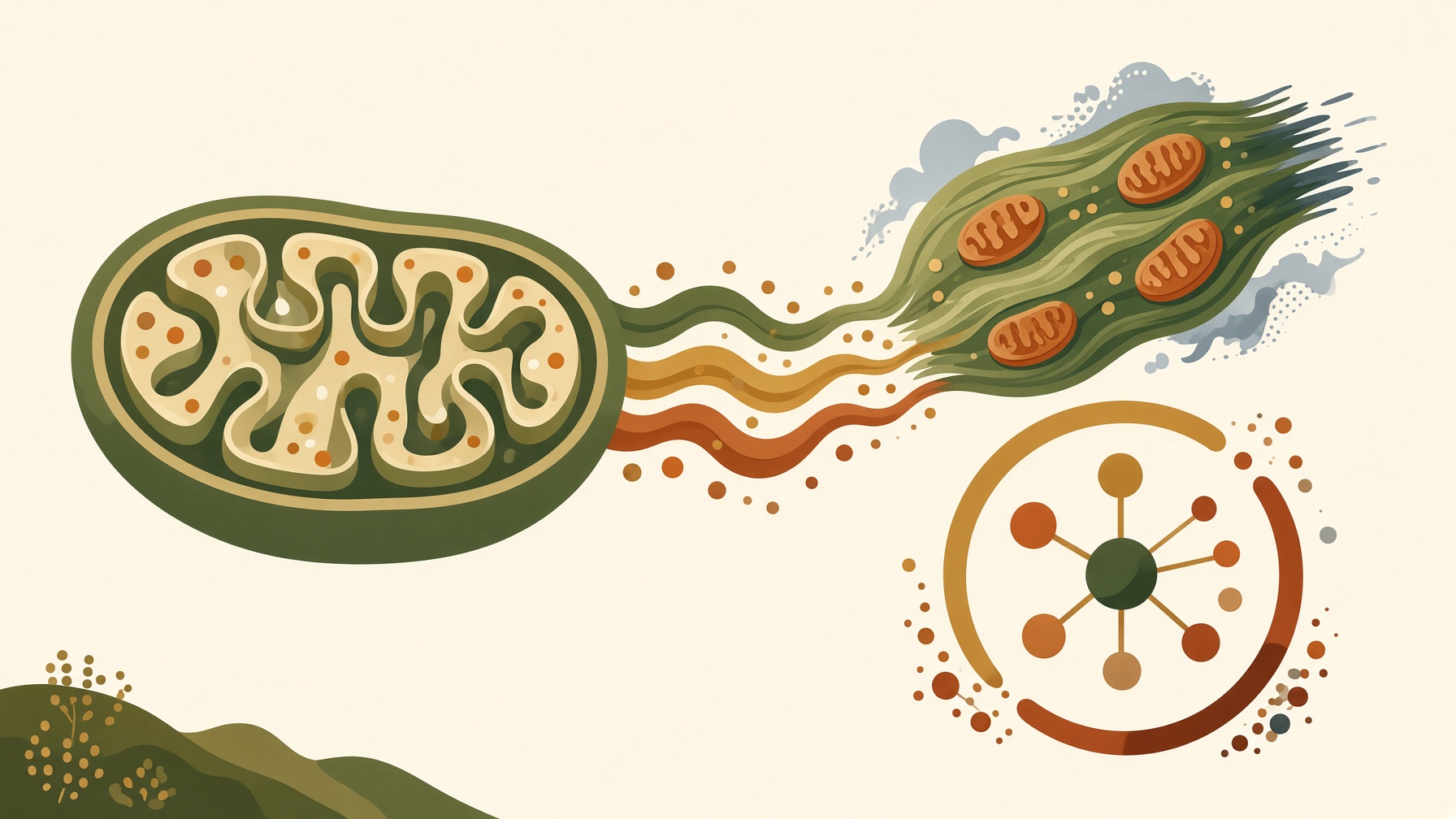
Every muscle contraction and many other forms of cellular work depend on ATP (adenosine triphosphate), a molecule cells use as an immediate source of usable energy, yet cells keep only a limited amount immediately available. That creates a constant metabolic problem: ATP is being used while new ATP must be regenerated fast enough to meet demand. How the body solves that problem changes dramatically between rest, a brief sprint, and prolonged exercise.
ATP is the principal immediate cellular energy carrier in the body. The amount available for immediate use is limited, however, so existing ATP stores cannot support cellular work for long on their own. ATP therefore has to be continually regenerated. The major energy systems are therefore better understood as overlapping routes for ATP regeneration rather than separate energy supplies assigned to different activities .1
The oxidative energy system is commonly called the aerobic system because oxidative phosphorylation depends on oxygen. Its relative contribution generally increases as exercise continues, although there is no single duration at which oxidative metabolism suddenly becomes dominant. The balance depends on exercise intensity, pacing, exercise mode, and individual characteristics. Oxidative metabolism can use both carbohydrates and fats as fuel sources .1,2
When ATP demand becomes very high over a brief period, the phosphagen system makes a substantial contribution. It uses phosphocreatine to regenerate ATP rapidly, making it particularly useful when ATP turnover must rise quickly, as during a brief all-out sprint. Its contribution is especially important during the first several seconds of maximal exercise and remains substantial during very brief high-intensity efforts as phosphocreatine stores are rapidly depleted. Other ATP-producing pathways are already contributing from the beginning, so the phosphagen system never operates as the sole source during those opening seconds .1,2
Glycolysis provides another rapid route for ATP regeneration through substrate-level phosphorylation and does not directly require oxygen. Its substrates can come from blood glucose or from muscle glycogen, which enters the pathway through glucose-6-phosphate. This pathway can make a large contribution during high-intensity, short-duration exercise. Glycolysis can regenerate ATP rapidly, but its capacity to support very high rates of ATP turnover is limited compared with oxidative metabolism. Its relative contribution can be large during brief, high-intensity exercise, but oxidative ATP production is increasing at the same time. As the effort continues, the balance progressively shifts toward a greater aerobic contribution rather than changing abruptly at a particular time point .1,2
The central idea is that all of these systems can contribute at the same time. Resting activity, an explosive sprint, and prolonged exercise differ mainly in how much each ATP-producing pathway contributes, not in whether individual systems are switched completely on or off. The balance continuously shifts as the demands of the activity change .2
The impressive part of ATP supply is not that the body has a different system waiting for every type of activity, but that ATP regeneration can adjust across an enormous range of demands. The chemistry supporting a quiet moment and an all-out sprint is organized differently in scale and emphasis, yet the same immediate energy currency must keep being replaced. That continuous matching of ATP supply to ATP use is what allows cellular work to continue.
Join the discussion
No account or email is required. Your display name and comment will be public.